Follow us on :

Raising capital is not simply about finding investors who have money to deploy. For startups, the more important question is whether a potential investor fits the company’s fundraising stage, industry, capital requirements, growth model, and long-term objectives.
That is why understanding family offices vs VCs vs angel investors matters.
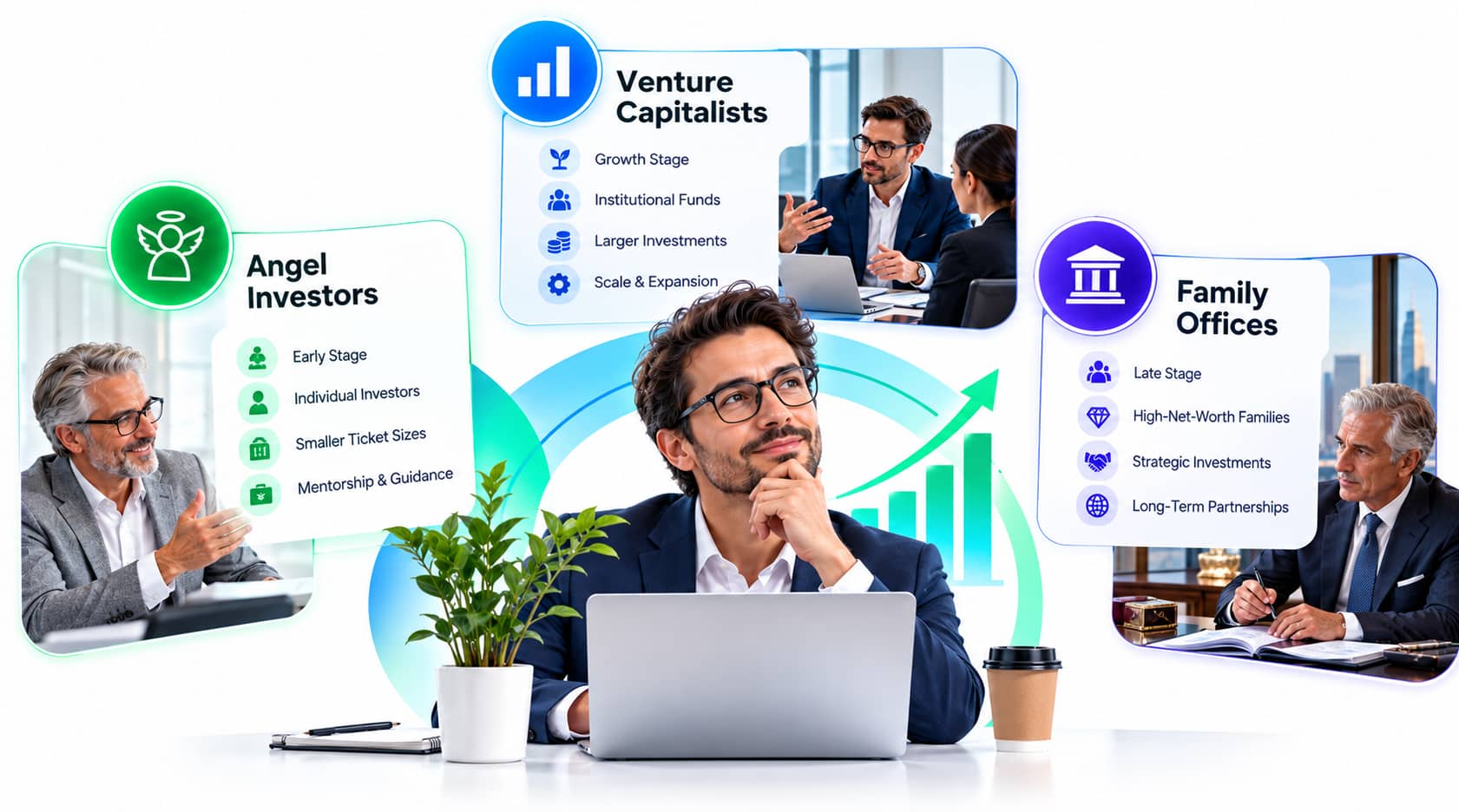
Angel investors may participate in early-stage rounds and often invest their own capital. Venture capital firms typically deploy capital through investment funds and follow defined strategies. Family offices can invest across multiple asset classes and may participate directly in startups or alongside other investors. The SEC notes that these investor categories can differ in their typical company stage, investment structure, involvement, and investment scale.
The right investor search therefore starts with a different question:
Which type of investor is relevant to my startup at this stage, and what evidence do I need to show them?
This guide breaks down family office investors, angel investors, and venture capital investors by fundraising stage and explains how startups can build a more targeted investor outreach strategy.
There is no universal investor sequence that applies to every startup. However, a practical research framework looks like this:
| Fundraising Stage | Investor Types to Research | What to Demonstrate |
|---|---|---|
| Idea / Pre-Seed | Angels, early-stage investors, selected family offices, pre-seed VCs | Founder expertise, problem, MVP, market opportunity |
| Seed | Angel investors, seed funds, family offices, seed-stage VCs | Early traction, customers, product-market signals |
| Series A | Venture capital investors, sector-focused funds, selected family offices | Repeatable growth, market opportunity, scalable model |
| Series B | Growth-oriented VCs, institutional investors, family offices | Strong growth, operational scale, market expansion |
| Later Stage | Growth investors, strategic investors, larger institutional funds, relevant family offices | Scale, financial performance, expansion strategy |
These are research categories, not fixed rules. Investor mandates vary significantly from one firm or family office to another.
Current fundraising data also shows why stage matters. Carta reported that U.S.-based startups raised $3.19 billion across more than 11,500 pre-seed instruments in Q2 2026, while the average pre-seed instrument size reached approximately $276,000.
Before building an investor list, it helps to understand what each category represents.
Angel investors are generally high-net-worth individuals investing their own money into emerging businesses. According to the SEC, angels commonly participate in early funding rounds, including seed and Series A, although individual investment behavior varies. Angels may also syndicate with other investors and can bring industry knowledge or advisory support.
For startups, relevant angel investors may include:
The key research question is not simply whether someone is an angel.
It is:
Does this angel invest in companies like mine at my current stage?
Venture capital investors manage investment funds and typically invest according to a defined strategy covering factors such as stage, geography, industry, ownership, and expected growth.
Some VCs focus on:
Others operate across multiple stages.
That means a startup should not treat every VC firm as a potential prospect.
A seed-stage founder researching a Series B-focused fund may be wasting valuable outreach capacity even if the firm’s overall portfolio looks attractive.
Family offices manage the wealth and investments of wealthy families. Some are highly diversified investment organizations, while others have specialized investment teams and direct-investment programs.
Importantly, family offices are not a single uniform investor category.
PwC’s 2025 Family Office Deals Study analyzed more than 20,000 family offices and found that family offices have increasingly professionalized and specialized their investment strategies. Its analysis also found that venture capital represented 31% of family-office investment activity in H1 2025 and that club deals remained a major structure.
J.P. Morgan’s 2026 Global Family Office Report similarly reports growing interest in direct investments, including direct investment in companies within areas such as AI.
So instead of assuming that every family office is a startup investor, founders should research whether the specific office:
| Factor | Angel Investors | Venture Capital Investors | Family Office Investors |
|---|---|---|---|
| Capital source | Typically personal capital | Fund capital | Family wealth |
| Typical focus | Often early stage | Depends on fund mandate | Varies significantly |
| Decision process | Individual or syndicate | Formal investment process | Varies by office |
| Industry focus | Individual preference | Usually defined by fund | May be broad or specialized |
| Startup involvement | Can be hands-on | Often structured | Varies |
| Follow-on capacity | Depends on investor | Often planned by fund | Depends on investment strategy |
| Investment horizon | Varies | Influenced by fund structure | Can vary substantially |
| Research priority | Investor history and expertise | Stage, thesis and portfolio | Direct-investment mandate and decision-maker |
Access CampaignLake's Industry-Specific Email Database
At the pre-seed stage, the startup may have an idea, prototype, MVP, early users, initial revenue, or another early validation signal.
The investor universe can include:
At this stage, the quality of your investor targeting can matter because the startup may not yet have the metrics that later-stage investors expect.
Carta’s 2026 pre-seed data shows continued concentration of capital into fewer deals, making investor targeting particularly relevant for founders preparing early-stage fundraising.
Depending on the business, investors may want to understand:
Instead of creating a massive list of every angel and VC you can find, build a smaller list based on:
Stage + Industry + Geography + Investor Type + Relevant Experience
That creates a more useful starting point for investor outreach.
The seed stage is often where the investor universe expands.
Potential targets can include:
At this point, your company may have more evidence to show investors.
A generic “startup investor” list is rarely enough.
A more useful seed investor database can be segmented by:
The goal is to identify relevant investors, not simply more investors.
Series A fundraising usually requires a more developed investment case.
Potential targets include:
At this point, investors may examine a company’s growth trajectory, market opportunity, product-market fit, business model, competitive position, and ability to deploy additional capital effectively.
Build a Series A investor profile around:
Stage fit
Does the investor actively participate in Series A?
Sector fit
Does the firm invest in your industry?
Geographic fit
Does it invest in your market?
Portfolio fit
Does it have experience with similar businesses?
Capital fit
Can it participate at the size of round you’re raising?
Partner fit
Is there an investment partner whose experience aligns with your company?
This is where researching the investor behind the fund becomes as important as researching the fund itself.
Later-stage fundraising often requires a different investor research process.
Potential targets can include:
The research should increasingly focus on:
At this stage, investors may also examine how the new capital will accelerate an already functioning business model.
Family offices can be relevant at multiple stages, but their investment mandates differ substantially.
Some family offices may invest directly in startups. Others may access venture through funds or co-investment structures.
PwC’s 2025 research found that family offices continued to use club deals extensively, with club deals representing 69% of family-office investment transactions in H1 2026.
This creates an important research question:
Is the family office looking for direct startup opportunities, fund investments, co-investments, or something else?
This is why a generic family office database is less useful than a well-segmented family office database.
Angel investors can be particularly relevant when a startup is still building its early proof points.
The SEC describes angels as generally high-net-worth individuals investing their own money and notes that many are entrepreneurs or former entrepreneurs. It also notes that angel investors can syndicate investments with others.
For example, a healthcare startup could prioritize angels with healthcare operating experience rather than simply targeting a large number of generic startup investors.
The answer depends on the specific VC’s mandate.
Before adding a VC to your outreach list, check:
1. Stage: Does the firm invest at your current stage?
2. Sector: Does it invest in your industry?
3. Geography: Does it invest in your market?
4. Portfolio: Has the firm invested in comparable companies?
5. Partner: Which partner typically handles investments like yours?
6. Capital: Does the firm participate at the level you need?
7. Follow-on Strategy: Does the firm have a strategy for subsequent rounds?
This qualification process prevents a common fundraising problem:
building a huge investor list without building a relevant investor list.
A strong investor outreach strategy should move through several stages.
Start with:
Your stage determines which investor categories should receive the most research attention.
Create an investor ICP.
For example:
Investor Type: Seed VC
Industry: B2B SaaS
Geography: United States
Stage: Seed
Relevant Experience: SaaS portfolio
Decision-Maker: Partner/Principal
Investment Thesis: Enterprise software
Now your search becomes much more precise.
Review:
Do not rely exclusively on a database record.
Use the database as a starting point for structured research and qualification.
Possible contacts include:
The exact title varies by organization.
Create separate segments such as:
Segment A: Seed VCs
Segment B: Healthcare investors
Segment C: SaaS investors
Segment D: Family offices
Segment E: Angel investors
Segment F: Strategic investors
Then personalize your outreach according to the segment.
Founders can combine multiple research channels.
Look for investment theses, portfolio pages, partners, and contact information.
Study companies already backed by a fund to understand sector and stage patterns.
Research angel groups and individual investors with relevant experience.
Identify offices with documented direct-investment or venture activity.
Use professional networks to identify decision-makers and potential introductions.
Use structured databases to organize investor information and build targeted prospect lists.
Existing founders, advisors, investors, accelerators, and industry contacts can sometimes provide introductions where appropriate.
The key is to combine discovery + qualification + personalization.
The database you build should match the fundraising strategy.
A family office database might contain:
A seed investor database could include:
The objective is not to collect every investor record available.
The objective is to create a qualified investor universe that your fundraising team can actually work.
Once you know the type of investor you want to research, structured contact data can make the prospecting process easier to organize.
A targeted investor email list can help fundraising teams identify and segment potential investor contacts according to criteria such as investor type, geography, industry, or role.
For example, a startup could organize research into:
However, contact data should be treated as one part of the process. Founders should still verify the investor’s current mandate, portfolio, stage, and relevance before beginning outreach.
Use this checklist before moving an investor into your active outreach pipeline.
Investor Qualification Checklist
Invests at your fundraising stage
Relevant industry experience
Relevant geographic focus
Compatible investment mandate
Appropriate investment range
Relevant portfolio companies
Identifiable decision-maker
No obvious portfolio conflict
Relevant expertise or network
Current investment activity
Contact information verified
Outreach personalized
This transforms investor prospecting from a volume exercise into a qualification process.
A first investor message should be concise and relevant.
A useful structure is:
Explain why you selected that investor.
Describe the startup in one clear sentence.
Include the most meaningful evidence available.
State the round and purpose where appropriate.
Explain why their investment focus is relevant.
Ask for a specific next step.
Why you → What we build → What we’ve achieved → What we’re raising → Why there’s a fit → Next step
The objective is not to send the longest pitch.
It is to make the relevance immediately understandable.
1. Contacting Every Investor
More contacts do not automatically mean better fundraising.
2. Ignoring Stage Fit
A Series B investor may not be relevant to a pre-seed startup.
3. Sending the Same Message to Everyone
Family offices, angels, and VCs can have different investment structures and mandates.
4. Not Researching Portfolio Companies
Portfolio research can reveal industry expertise, potential conflicts, and relevant connections.
5. Focusing Only on Investor Name
The actual decision-maker matters.
6. Ignoring Geography
Some investors have specific regional mandates.
7. Treating Family Offices as One Category
Family offices vary considerably in investment strategy and direct-investment activity.
8. Prioritizing Database Size Over Qualification
A 10,000-record list can be less useful than a smaller, carefully qualified investor universe.
Use this four-part framework before beginning outreach:
Where are you now?
Pre-seed → Seed → Series A → Series B → Growth
Does the investor actually invest at this stage?
What does your startup have that supports the investment case?
Who is the most relevant person to approach?
This creates a simple sequence:
Stage → Investor Type → Investor Fit → Decision-Maker → Personalized Outreach
The most useful way to think about family offices vs VCs vs angel investors is not as a competition between three investor categories.
They represent different sources of capital with different structures, mandates, decision processes, and potential areas of involvement.
Angel investors can be relevant to early-stage companies, while VC firms may invest across defined stages depending on their fund strategy. Family offices can participate in direct investments, funds, or co-investments, but their strategies vary considerably. The SEC specifically notes that investor categories differ in profile, stage, structure, involvement, and investment scale.
For founders, the practical approach is therefore:
Identify your stage → define your investor profile → research investor fit → identify the right decision-maker → personalize your outreach.
The quality of your investor research can matter just as much as the size of your prospect list.
Angel investors are generally individuals investing their own capital, VC firms manage investment funds according to defined strategies, and family offices manage and invest family wealth. Their investment stages, structures, involvement, and decision processes can vary considerably.
Startups may research angel investors, pre-seed funds, early-stage VCs, and selected family offices. The appropriate targets depend on the company’s industry, geography, capital requirement, traction, and investor mandate.
Potential seed investors include angel investors, seed funds, venture capital investors, family offices, and specialized investment groups.
A startup should research VC firms when its stage, traction, market, geography, and growth model align with the firm’s investment mandate. Not every VC invests at every stage.
Research angel networks, individual investors, founders, executives, and industry specialists with relevant investment history. Then qualify prospects according to stage, industry, geography, and expertise.
Start by identifying family offices with documented investment activity relevant to your industry and stage. Research whether they make direct startup investments, participate in co-investments, or invest through funds.
A family office database is a structured collection of information about family offices, potentially including investment focus, geography, portfolio activity, decision-makers, and contact information.
A seed investor database organizes potential seed-stage investors according to attributes such as fund, stage, industry, geography, investment focus, decision-maker, and contact information.
Start with your fundraising stage and ideal investor profile. Then segment investors by stage, industry, geography, investment strategy, and relevant decision-maker before beginning personalized outreach.
A startup can research multiple investor categories simultaneously when their mandates are relevant. The key is to tailor the target list and messaging rather than treating all investors as interchangeable.
Successful fundraising is not simply a numbers game.
A founder can have hundreds or thousands of potential investor contacts and still struggle if the list does not reflect the company’s actual fundraising stage and investor profile.
The more useful approach is to build a qualified investor universe:
Fundraising stage → Investor type → Industry fit → Geographic fit → Investment fit → Decision-maker → Personalized outreach.
Whether you are researching angel investors, seed investors, venture capital investors, or family office investors, the objective is the same: find the investors whose mandate and interests actually align with what your startup is building and where the company is today.
Ready to Reach More Decision-Makers?
Access verified business decision-maker data worldwide. Filter, download and build targeted outreach lists in minutes—without manual scraping or guesswork.

Tanoj Kumar writes the CampaignLake blog's guides on B2B data, industry and professional email lists, and B2B lead generation.