Follow us on :

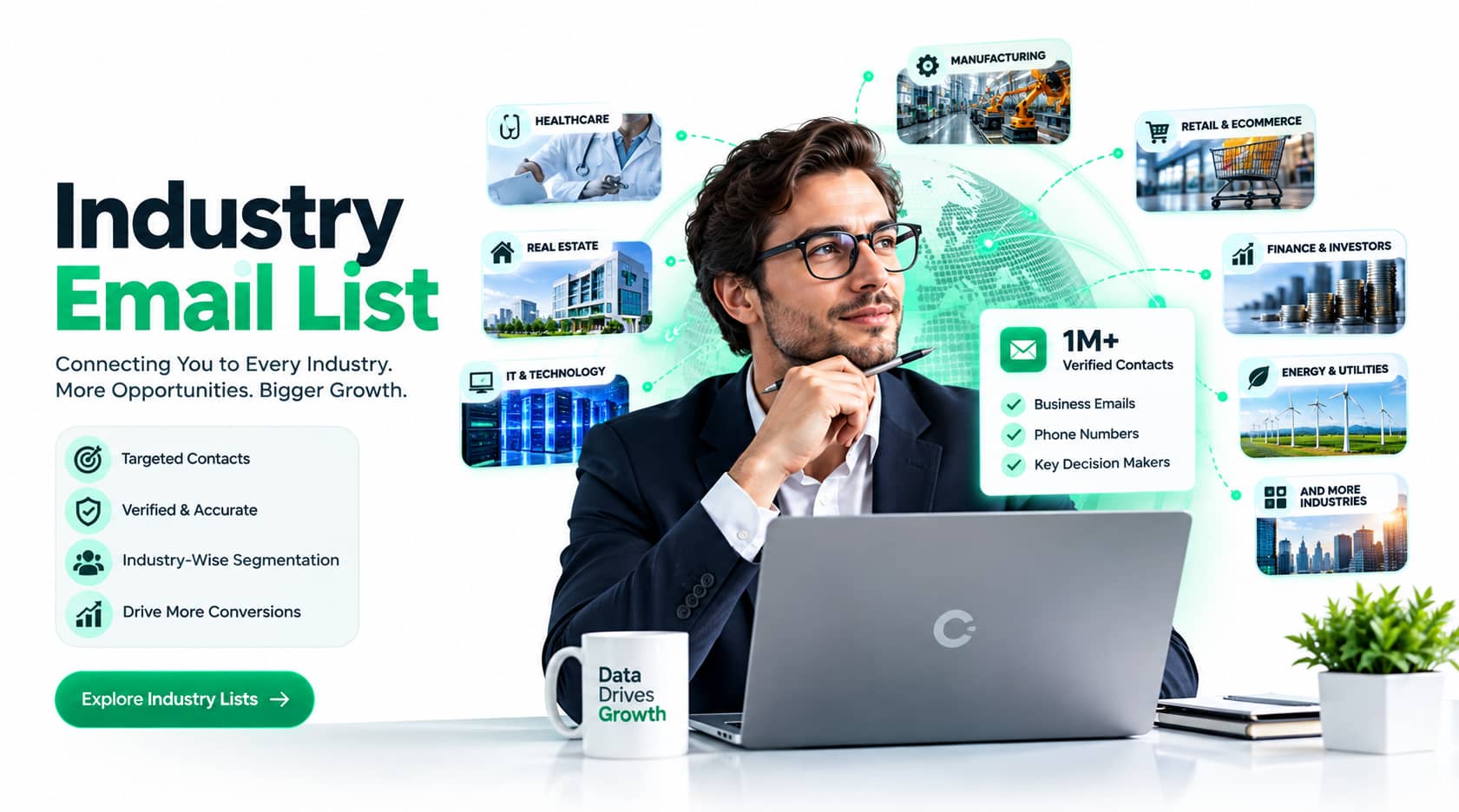
Building a large contact database is easy. Building a targeted industry email list that contains relevant companies, the right decision-makers, accurate business contact information, and useful segmentation data is much harder.
For B2B companies, the difference matters. A broad database may contain thousands of contacts, but if those contacts do not match your ideal customer profile (ICP), your sales team spends time researching poor-fit prospects and your marketing campaigns become less relevant.
A targeted industry email list solves this by organizing B2B prospects around the characteristics that matter to your sales strategy—industry, job function, seniority, company size, geography, revenue, technology, and other qualification signals.
To build a targeted industry email list, define your ideal customer profile, identify the industries and decision-makers you want to reach, collect and enrich relevant business data, verify contact information, segment prospects using multiple filters, and continuously maintain the database.
The goal is not to create the biggest list.
The goal is to create a usable list of relevant prospects that your sales and marketing teams can act on.
An industry email list is a database of business contacts organized around a specific industry or group of industries.
Depending on the use case, an industry email list can include:
Unlike a broad business database, an industry-specific list allows marketers and sales teams to narrow an audience around a particular market.
For example, a cybersecurity company may not need a general list of every business in the United States. It may need CISOs, CIOs, IT directors, and security leaders at mid-market companies in selected industries and geographic markets.
That difference—between volume and relevance—is the foundation of effective B2B list building.
B2B buyers are not one homogeneous audience.
A healthcare company, SaaS company, manufacturer, real estate firm, and financial institution can have completely different buying processes, terminology, regulations, budgets, and decision-makers.
Industry segmentation allows your outreach to reflect those differences.
Industry targeting helps remove businesses that are unlikely to need your product or service.
Instead of sending one campaign to a broad audience, you can create separate segments for the markets your business actually serves.
Industry data becomes more useful when combined with job title and seniority.
For example:
Industry: Healthcare
Department: Information Technology
Seniority: Director+
Target roles: CIO, CTO, IT Director, VP of IT
This creates a significantly more actionable audience than simply selecting “healthcare.”
Different industries have different problems.
A message written for a hospital administrator should not necessarily be identical to one written for a SaaS founder.
Industry segmentation allows you to personalize:
ABM programs require accurate account and contact information.
An industry email list can help sales teams identify multiple stakeholders within target accounts and organize outreach by account, role, and buying group.
Instead of researching every company manually, sales teams can begin with a predefined audience that already matches their targeting criteria.
That shifts the work from:
“Who should we contact?”
to:
“Which qualified accounts should we prioritize first?”
Building a useful industry email list involves more than collecting email addresses.
Use this eight-step process.
Before collecting any contacts, define exactly what a qualified prospect looks like.
Your ICP should answer:
Example ICP
A B2B software company might define its ICP as:
U.S.-based SaaS companies with 50–500 employees, targeting VP-level and C-suite revenue and marketing decision-makers.
That single sentence can become the foundation for list segmentation.
Modern B2B list-building guidance similarly recommends combining firmographic criteria, buying roles, triggers, and disqualifiers rather than relying on one broad industry filter.
Once the ICP is clear, identify the industries where your product has the strongest use case.
Potential B2B verticals include:
Do not automatically target every available industry.
Instead, ask:
Where does our solution solve a specific, identifiable business problem?
A smaller list of highly relevant industries can be more useful than a massive database containing unrelated prospects.
Industry is only the first filter.
Your next question should be:
Who actually influences or owns the buying decision?
Depending on the product, relevant contacts might include:
Executive Leadership
Sales & Revenue
Marketing
Technology
Operations
The correct titles depend on your product and buying committee.
Industry + role + seniority is generally more useful than industry targeting by itself. Current industry-list providers and B2B lead-generation guides prominently use this multi-filter approach.
Geography can dramatically change the usefulness of a B2B list.
You can segment prospects by:
You can also segment by company characteristics such as:
Example
Instead of:
Healthcare companies
use:
U.S. healthcare companies → 200–1,000 employees → Texas → IT leadership → Director+
That is a much more specific audience.
There are several ways to build an industry email list.
First-Party Data
First-party data can come from:
This is valuable because the organization has an existing relationship with the contact.
Public Business Sources
Depending on the market and applicable rules, businesses can research:
B2B Data Providers
A specialized B2B data provider can provide pre-structured contact and company information based on defined filters.
This approach can be useful when the sales team needs to build a specific market segment without manually researching every account.
The important question is not simply “How many records are available?”
Ask:
“How closely do the records match my ICP, and how is the information sourced, verified, maintained, and delivered?”
A basic email address is rarely enough for modern B2B prospecting.
Enrichment adds context that allows sales and marketing teams to qualify and personalize prospects.
Useful enrichment fields include:
| Data Category | Examples |
|---|---|
| Contact | Name, email, phone |
| Role | Title, department, seniority |
| Company | Name, website, headquarters |
| Firmographics | Industry, employees, revenue |
| Geography | Country, state, city, ZIP |
| Technology | CRM, ecommerce, cloud, marketing tools |
| Organization | Parent company, subsidiaries |
| Qualification | ICP fit, account status |
| Buying Signals | Hiring, expansion, technology changes |
The more useful context you have, the easier it becomes to build meaningful segments.
A targeted list can still perform poorly if its contact information is outdated.
Before using a list, establish a data-quality process.
Check for:
B2B contact information changes over time because people change jobs, companies restructure, domains change, and businesses close. Current B2B data guides therefore emphasize ongoing verification and list hygiene rather than treating a database as permanently accurate.
A Simple Data-Quality Workflow
Collect → Enrich → Validate → Deduplicate → Segment → Review → Activate → Revalidate
This should be treated as a continuous process.
This is where an ordinary industry list becomes a targeted prospecting database.
A strong segmentation framework looks like this:
Industry
↓
Sub-industry
↓
Geography
↓
Company Size
↓
Department
↓
Job Function
↓
Seniority
↓
Technology
↓
Buying Signal
Example
Instead of:
100,000 Technology Contacts
create segments such as:
U.S. SaaS companies + 51–500 employees + VP Sales + Director+ + Salesforce users
Now the campaign has a clear audience, message, and business context.
A useful B2B industry email list should contain enough information to answer three questions:
Who is the person?
Where do they work?
Why might they be relevant to the campaign?
Recommended fields include:
Not every campaign needs every field.
The right data depends on the ICP and campaign objective.
Different industries require different targeting strategies.
Potential audiences include:
Healthcare campaigns often require more precise segmentation because clinical, administrative, technology, and procurement audiences have different responsibilities.
Potential audiences include:
Technology campaigns can also benefit from technographic segmentation.
Possible segments include:
Possible segments include:
Possible audiences include:
The key principle is simple:
Do not build one generic message for an entire industry if the buying roles have different problems.
Access CampaignLake's Industry-Specific Email Database
These terms are related but not identical.
| Factor | Industry Email List | Generic B2B Email List |
|---|---|---|
| Primary targeting | Industry | Broad business audience |
| Segmentation | Industry-focused | Often broader |
| Messaging | Vertical-specific | General |
| Personalization | More contextual | More limited |
| ABM use | Strong fit | Depends on data |
| Niche campaigns | Strong fit | Requires additional filtering |
| Research effort | Lower when properly segmented | Potentially higher |
A generic B2B database can still be useful when your ICP spans multiple industries.
The important factor is whether the available data can be filtered to match your actual audience.
Having the data is only the first stage.
You need a campaign strategy around it.
Create separate campaigns for separate audience segments.
For example:
Campaign A: SaaS CEOs
Campaign B: SaaS VP Sales
Campaign C: SaaS Marketing Directors
The offer and messaging can then reflect the recipient’s responsibilities.
Select high-value accounts and identify multiple relevant stakeholders.
For example:
Target account → CIO → IT Director → Procurement → Security Leader
This creates a multi-threaded account strategy instead of relying on a single contact.
Industry data can support different nurture paths.
A healthcare prospect might receive healthcare-specific case studies.
A manufacturing prospect might receive manufacturing-specific implementation examples.
Industry segmentation can help organizations promote:
Promote industry-specific:
to the audiences most likely to find them useful.
Personalization does not mean adding someone’s first name to a generic email.
Useful personalization connects the message to the prospect’s business context.
Weak personalization
Hi John, we help companies improve their marketing.
More contextual personalization
Hi John, we work with SaaS revenue teams that are trying to improve pipeline visibility across marketing and sales.
The second message uses:
Industry + function + business problem
You can personalize around:
The more specific the segment, the easier it becomes to write relevant messaging.
Before purchasing or using any B2B database, evaluate these factors.
1. Accuracy: Are contact and company details current?
2. Freshness: When was the information last checked?
3. Verification: How are email addresses validated?
4. Coverage: Does the database actually contain your niche audience?
5. Segmentation: Can you filter by industry, role, seniority, geography, and company characteristics?
6. Completeness: Does each record contain the fields your sales team needs?
7. Duplicate Control: Are duplicate contacts and companies removed?
8. Data Governance: Can the provider explain how data is sourced, maintained, and used?
9. Delivery Format: Can the data be exported into your workflow?
10. Compliance: Does your use of the data comply with the applicable laws and platform rules?
A large database is not automatically a high-quality database.
Both approaches can make sense.
Best when you need:
The downside is that manual research can require significant time and ongoing maintenance.
Useful when you need:
For many organizations, the practical approach is:
First-party data + researched accounts + verified external data + continuous CRM hygiene
This allows the business to combine relationship data with broader market coverage.
CampaignLake’s Industry Email List is designed around the same core principle: start with the audience you want to reach and then apply relevant segmentation criteria.
CampaignLake describes its industry data as segmented by factors including industry, job title, location, company size, revenue, and industry classifications, with contact fields such as business email, phone number, company information, and other data attributes.
The broader CampaignLake B2B database also organizes audiences across industry, professional, executive, healthcare, technology, and other categories.
Instead of requesting a generic industry database, define your audience around:
Industry + Location + Company Size + Job Function + Seniority + Additional Criteria
For example:
U.S. manufacturing companies → 100–1,000 employees → procurement leaders → Director+.
This creates a much clearer campaign audience than simply requesting “manufacturing contacts.”
Industry-specific B2B data can support workflows such as:
CampaignLake also positions its industry data for multichannel campaigns, including email, calling, direct mail, and social outreach.
If your target market is highly specific, a custom segment can be more useful than selecting a broad industry category.
Define:
Who → Where → What type of company → Which roles → Which seniority → Which additional criteria
Then build the list around those requirements.
Mistake 1: Choosing the Largest List
More contacts do not automatically mean more qualified opportunities.
Mistake 2: Targeting an Industry Without Defining Roles
“Healthcare” is an industry.
It is not an ICP.
Mistake 3: Ignoring Company Size
A 20-person company and a 20,000-person enterprise may have completely different buying processes.
Mistake 4: Using One Message for Every Industry
Industry-specific problems require industry-aware messaging.
Mistake 5: Skipping Verification
Outdated contact data can reduce campaign efficiency and create unnecessary delivery problems.
Mistake 6: Forgetting Data Freshness
A database should be maintained rather than treated as a permanent snapshot.
Mistake 7: Ignoring Disqualifiers
A good targeting strategy specifies who should not be included.
Mistake 8: Measuring Only Email Volume
Track qualified replies, meetings, opportunities, and pipeline—not just the number of contacts reached.
There is no universal refresh interval that works for every database.
The appropriate frequency depends on:
Instead of asking only:
“How often is this database updated?”
also ask:
“What verification process happens between updates?”
A strong maintenance process can include:
Revalidate → Remove invalid records → Update job changes → Add new contacts → Deduplicate → Re-segment
Separate data quality from campaign performance.
Track:
Track:
This distinction matters.
A campaign can have strong delivery but weak targeting.
Likewise, an excellent audience can perform poorly because the message or offer is not relevant.
Email outreach must be planned around the laws and requirements applicable to the sender, recipient, jurisdiction, data source, and campaign.
Depending on the situation, businesses may need to consider requirements such as:
Important practices can include:
No database is a substitute for your own legal and compliance review.
Compliance is determined by how data is collected, processed, transferred, and used—not simply by putting the word “compliant” on a database.
An industry email list is a database of business contacts organized around a specific industry or group of industries. Depending on the dataset, it can contain business emails, names, job titles, company information, locations, company size, industry classifications, phone numbers, and other attributes used for B2B prospecting and segmentation.
Email verification can include syntax checks, domain checks, mailbox validation, duplicate detection, and review of outdated contact information. Verification should occur before activation and periodically afterward because B2B contact information changes.
Segment by industry, sub-industry, geography, company size, revenue, department, job function, seniority, technology, account type, or other relevant qualification criteria. Combining several filters usually creates more specific audiences than using industry alone.
Yes. An industry database can help identify target accounts and relevant stakeholders within those companies. For ABM, teams can combine company-level targeting with multiple contacts across functions such as executive leadership, operations, IT, finance, procurement, and marketing.
A successful industry email list is more than a spreadsheet of business email addresses.
It is a structured audience built around a clear ideal customer profile.
The strongest process is:
Define your ICP → choose target industries → identify decision-makers → apply company and geographic filters → source data → enrich records → verify contacts → segment audiences → personalize outreach → measure results → continuously refresh the database.
The biggest opportunity is not simply finding more contacts.
It is finding more relevant contacts.
When industry, company, role, seniority, geography, and business context align, sales and marketing teams can create more focused campaigns and spend less time sorting through prospects that were never a good fit.
If your team needs to build a targeted audience across specific industries, locations, company sizes, and decision-maker roles, CampaignLake’s Industry Email List can be used as a starting point for creating a customized B2B prospect segment.
Ready to build a more targeted B2B audience? Define your ICP first, then build your industry email list around it.
Ready to Reach More Decision-Makers?
Access verified business decision-maker data worldwide. Filter, download and build targeted outreach lists in minutes—without manual scraping or guesswork.

Tanoj Kumar writes the CampaignLake blog's guides on B2B data, industry and professional email lists, and B2B lead generation.