Follow us on :

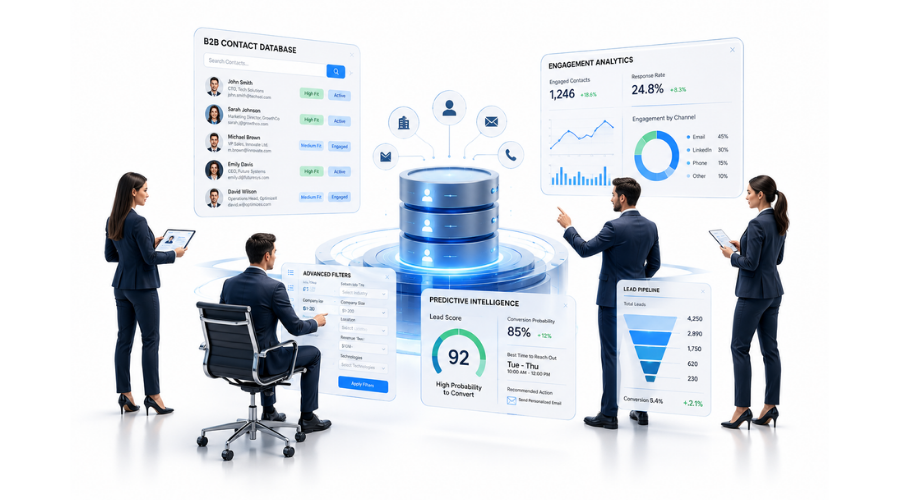
In today’s hyper-competitive digital economy, businesses need more than just leads — they need accurate, enriched, and actionable data. That’s why B2B email lists have become one of the most important assets for modern sales and marketing teams.
Whether you’re a SaaS startup, healthcare marketer, recruitment agency, enterprise software provider, or real estate business, having access to verified business contacts helps improve targeting, increase conversions, and accelerate revenue growth.
Modern buyers expect personalized communication and relevant outreach. Random cold emails and mass prospecting strategies are no longer effective. Companies that leverage high-quality sales intelligence data consistently outperform competitors by reaching the right decision-makers with the right message at the right time.
In this guide, we’ll explore 12 practical and high-impact ways businesses use B2B contact databases in 2026 to improve prospecting, scale outreach, strengthen account-based marketing, and generate more qualified leads.
A B2B contact database is a collection of verified business information that organizations use for prospecting, lead generation, and sales intelligence.
These databases typically contain:
High-quality B2B databases help organizations connect directly with relevant professionals and key stakeholders across industries.
Instead of spending hours manually researching prospects, businesses can instantly access targeted contact information that supports scalable outbound campaigns.
The way companies buy and sell has changed dramatically.
Sales cycles are longer, competition is higher, and buyers are more informed than ever before. To stay competitive, businesses need reliable data that enables smarter decisions and faster execution.
Here’s why B2B contact databases are essential in 2026:
Organizations that rely on outdated or incomplete data often struggle with low email deliverability, poor response rates, and wasted sales effort.
One of the biggest advantages of using B2B contact databases is the ability to create laser-focused prospecting lists.
Modern databases allow businesses to filter contacts using advanced criteria such as:
For example, a cybersecurity SaaS company can specifically target:
This precision dramatically improves outreach efficiency and helps sales teams focus only on high-potential prospects.
Targeted prospecting also reduces wasted outreach and improves sales productivity.
SaaS businesses rely heavily on predictable lead pipelines.
Using verified B2B contact databases, SaaS companies can:
Accurate data allows SaaS marketers to personalize campaigns based on company size, technology usage, and business needs.
This is especially important in competitive SaaS industries where personalization directly impacts conversion rates.
Strong SaaS lead generation strategies now depend on reliable sales intelligence data.
Account-based marketing has become one of the most effective B2B growth strategies.
However, ABM campaigns require highly accurate company and contact data to succeed.
B2B contact databases help teams:
Instead of targeting broad audiences, companies can focus resources on accounts with the highest revenue potential.
This improves efficiency and increases deal-closing opportunities.
Generic outreach rarely works anymore.
Modern buyers expect businesses to understand their challenges, goals, and industry needs.
Using enriched B2B contact data, sales teams can personalize emails using:
For example, a marketing automation company targeting healthcare firms can tailor messaging differently for hospital administrators versus private clinic owners.
Personalized campaigns generate significantly higher open rates, reply rates, and engagement levels compared to generic email blasts.
Poor data quality is one of the biggest reasons outbound campaigns fail.
Common problems include:
High-quality B2B contact databases help organizations maintain clean and reliable CRM systems through:
Better contact data quality improves deliverability and helps sales teams spend more time selling instead of cleaning spreadsheets.
Lead enrichment transforms basic contact records into highly valuable prospect profiles.
Instead of storing only a name and email address, enriched profiles may include:
This additional context helps businesses prioritize leads more effectively.
Lead enrichment also improves personalization across email, LinkedIn outreach, paid advertising, and cold calling campaigns.
Modern B2B prospecting is no longer limited to email alone.
Businesses now engage prospects across multiple channels, including:
B2B contact databases provide the accurate information needed to coordinate multi-channel campaigns effectively.
Multi-channel engagement increases brand visibility and improves response opportunities.
Sales leaders use B2B databases to improve territory management and account distribution.
Teams can organize accounts based on:
This helps businesses:
Proper territory planning ensures sales teams focus on the best opportunities.
Many businesses want to find companies similar to their best customers.
Using B2B contact databases, organizations can identify lookalike audiences based on:
This allows businesses to scale prospecting more efficiently while maintaining lead quality.
Lookalike targeting is particularly effective for SaaS startups and B2B service providers looking to expand rapidly.
Investor outreach requires highly targeted contact information.
Businesses use B2B databases to connect with:
This helps companies improve:
Platforms like CampaignLake provide verified investor databases that help businesses streamline outreach and improve engagement.
Healthcare is one of the most data-driven industries in B2B marketing.
Healthcare companies use B2B contact databases to reach:
Accurate healthcare data helps organizations:
Verified healthcare contact data is essential for successful medical marketing campaigns.
Real estate businesses also rely heavily on accurate B2B data.
Companies use contact databases to reach:
This helps improve outreach for:
Targeted prospecting improves lead quality and increases campaign ROI in highly competitive real estate markets.
CampaignLake provides verified B2B contact databases that help businesses improve sales intelligence and lead generation performance.
CampaignLake supports industries such as:
Their database solutions help businesses:
By focusing on verified and segmented data, CampaignLake helps organizations improve marketing efficiency and sales productivity.
Business information changes constantly. Regular verification helps maintain data accuracy.
Use enriched insights to tailor outreach based on industry, company size, and buyer intent.
Avoid broad campaigns. Create focused segments for higher engagement and conversion rates.
Follow regulations such as:
Always include opt-out options and follow ethical outreach practices.
Connect databases with tools like:
CRM integration improves workflow efficiency and campaign tracking.
Ready to Reach More Decision-Makers?
Access verified business decision-maker data worldwide. Filter, download and build targeted outreach lists in minutes—without manual scraping or guesswork.
A B2B contact database is a collection of verified business information that helps companies connect with decision-makers for sales, marketing, and lead generation campaigns. These databases typically include emails, phone numbers, company details, job titles, firmographics, and technographic data.
B2B contact databases are critical because sales teams need accurate, real-time data to personalize outreach, improve targeting, and increase conversions. Modern outbound sales strategies rely heavily on enriched contact intelligence and buying signals.
B2B contact databases support sales intelligence by helping businesses:
Modern sales intelligence platforms combine contact data with buyer signals and automation workflows.
Most B2B databases include:
Advanced providers also offer AI-ready and real-time enrichment data
Accuracy depends on how frequently the provider verifies and refreshes the data. Top providers use:
Industry research shows B2B data decays quickly as professionals change jobs or companies.
Most experts recommend continuous updates or quarterly refreshes because business data changes rapidly. Job changes, promotions, company growth, and restructuring can make databases outdated quickly.
A CRM stores customer and prospect information your business already owns, while a B2B contact database provides new external prospect data for lead generation and outbound sales campaigns.
Popular CRM platforms include:
In 2026, successful B2B growth strategies are built on accurate sales intelligence and reliable business data.
Companies that leverage high-quality B2B contact databases gain a significant competitive advantage through smarter targeting, better personalization, and more effective outreach campaigns.
Whether you’re focused on SaaS lead generation, healthcare marketing, investor outreach, or real estate prospecting, verified contact data plays a critical role in modern sales success.
Businesses that invest in reliable B2B data solutions can:
As competition continues to grow across industries, organizations that use accurate sales intelligence data will be better positioned to build stronger pipelines and drive long-term revenue growth.

Ben Williams is a leading voice in B2B email marketing and data-driven lead generation. Known for his strategic mindset and deep understanding of high-performance email lists, Ben helps businesses cut through the noise and connect with their ideal audience. With a background rooted in growth marketing and sales enablement, he transforms raw data into revenue-generating campaigns that consistently deliver results. His work empowers organizations to streamline prospecting, boost conversions, and maximize ROI. Beyond the inbox, Ben stays at the forefront of emerging trends in data intelligence and B2B engagement, always seeking innovative ways to elevate campaign performance.