ISO 27001 certified & SOC 2 Type II attested · Works to comply with GDPR, CCPA & CASL
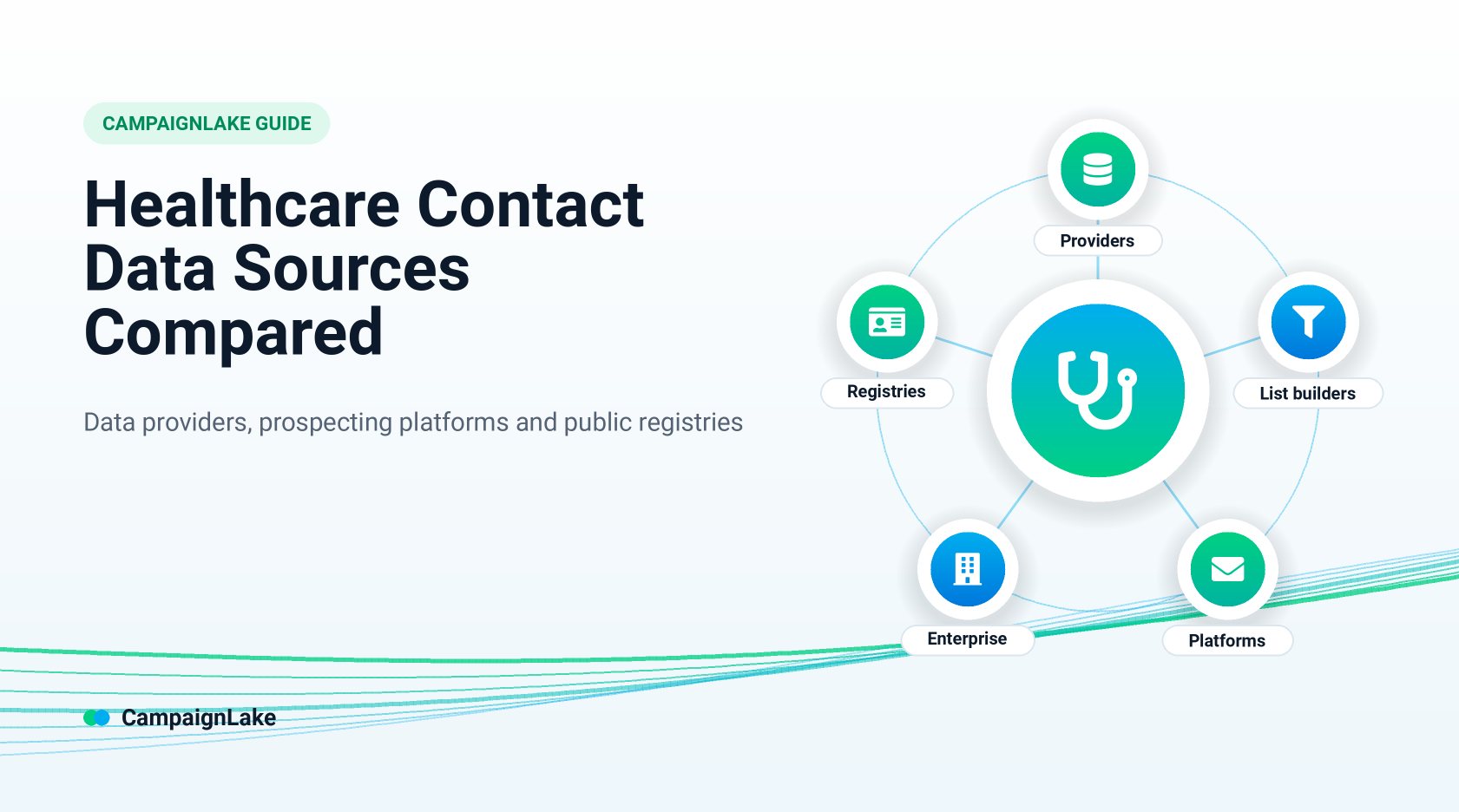
Quick answer: Healthcare contact data comes from five main kinds of sources: custom data providers that build lists to your criteria, self-serve list builders, prospecting platforms with built-in outreach tools, enterprise B2B intelligence platforms and free public sources such as the NPI Registry. The right choice depends on how specialised your audience is, how many contacts you need, whether you need ongoing access or a one-time list, and how much verification work you can do yourself.
Teams planning healthcare outreach often start by asking which vendor to use. A better first question is which type of source fits the job. A medical device company targeting interventional cardiologists in five states has very different needs from a SaaS team prospecting practice managers every week.
This guide compares the main source types, what each does well and where each falls short. CampaignLake publishes this guide and is one of the providers described; we have kept descriptions of other companies general, so check their current features directly. If you already know you need a custom list, see the healthcare email list page.
In modern healthcare marketing, success depends on reaching the right professionals with the right message at the right time. A verified healthcare email list is more than just contact data—it’s a direct channel to physicians, nurses, administrators, and healthcare decision-makers who influence purchasing, partnerships, and patient care outcomes.
Using outdated or generic contact data can quickly drain your marketing budget. Emails sent to inactive or incorrect contacts lead to poor deliverability, increased bounce rates, and reduced engagement. On the other hand, a verified healthcare email database ensures your campaigns reach active, qualified professionals—helping you improve open rates, boost conversions, and maximize your return on investment.
Healthcare outreach often involves several sets of rules: email marketing laws such as CAN-SPAM in the US or CASL in Canada, privacy laws such as GDPR for EU contacts, and your own industry’s promotional rules. Whichever source you use, you remain responsible for assessing consent, privacy and marketing requirements for each campaign. Ask every source how its data is collected so you can make that assessment. See is it legal to buy an email list for a country-by-country overview.
Healthcare professionals span a wide range of specialties, roles, and practice settings. A high-quality healthcare contact database allows you to segment your audience based on criteria such as specialty, job role, location, hospital affiliation, and more. This enables you to deliver highly relevant, personalized campaigns that resonate with your target audience and drive better engagement.
A verified healthcare contact data is essential for executing effective, real-world marketing strategies. Pharmaceutical companies use these lists to promote new therapies and clinical updates. Healthcare technology providers connect with decision-makers to drive product adoption. Hospitals and clinics leverage them for recruitment and service promotion. Without accurate data, these campaigns lack direction and fail to deliver meaningful results.
Access CampaignLake's Healthcare Decision-Maker Database
Whatever type of source you choose, the same questions decide whether the data will work for your campaign.
One of the biggest challenges in healthcare marketing is maintaining clean and reliable data. A trusted provider should follow a rigorous multi-layer verification process that includes:
A well-maintained healthcare email database ensures your campaigns reach active professionals, minimizing bounce rates and improving deliverability.
Healthcare is a diverse industry, and broad targeting rarely works. The best providers offer detailed segmentation options so you can reach the right audience with precision. Look for filters such as:
With a properly segmented healthcare contact list, you can create personalized campaigns that resonate with your audience and drive higher engagement.
Ask each source to explain where its records come from, how often they are checked, how opt-outs are handled and what you may do with the data. A source that cannot answer clearly makes it hard for you to assess your own obligations under laws such as CAN-SPAM, CASL, GDPR or CCPA.
The cost of a healthcare contact list can vary significantly depending on data quality, targeting depth, and volume. Reliable providers typically offer:
Instead of choosing the lowest-priced option, focus on value. High-quality, verified data often delivers better engagement and a stronger return on investment.
Top-tier providers go beyond just selling data—they help you succeed with it. Look for vendors that offer:
These additional services ensure your healthcare contact lists are not only accurate but also aligned with your marketing objectives for maximum impact.

Custom providers build a list to your criteria (specialty, role, facility type, geography) and deliver a file you can load into your CRM. They suit specialised audiences and one-off or periodic campaigns, and usually offer a sample before purchase. Trade-off: you buy a defined dataset rather than ongoing database access.
CampaignLake works this way; see the healthcare email list, physicians email list and hospital decision makers pages, or how CampaignLake sources and verifies data.
Self-serve builders let you filter a database online and download contacts immediately, usually paying per record or by credits. They are fast and convenient for broad audiences. Trade-off: niche healthcare roles and facility-level detail can be harder to filter precisely, and verification depth varies, so test exports before large campaigns.
Prospecting platforms combine a contact database with sequencing, dialling and CRM integrations, typically on a per-seat subscription. They suit sales teams prospecting continuously across many industries. Trade-off: healthcare coverage is one part of a general database, so specialised clinical audiences may need supplementing.
Enterprise platforms offer large databases plus company intelligence, intent signals and integrations, usually on annual contracts. They suit large sales and marketing organisations that prospect across many markets. Trade-off: cost and contract length can be high for teams that only need healthcare contacts occasionally. Some vendors in this group emphasise European data and compliance documentation, which matters for international campaigns.
Free sources such as the NPI Registry, state licensing boards and practice websites are authoritative for identifying providers and checking licences. Trade-off: they do not include email addresses, rely on self-reported updates and take staff time to research at scale.
| Source type | Best for | Typical model | Watch for |
|---|---|---|---|
| Custom data provider | Specialised audiences, defined campaigns | Per list, quoted on criteria | Usage rights and refresh terms |
| Self-serve list builder | Fast, broad pulls | Per record or credits | Filter depth for clinical roles |
| Prospecting platform | Continuous sales prospecting | Per-seat subscription | Healthcare coverage depth |
| Enterprise intelligence platform | Large teams, many markets | Annual contract | Cost relative to healthcare use |
| Public registries and research | Verification, small projects | Free, staff time | No emails; self-reported updates |
Features and pricing change often; confirm current details with each vendor before deciding.
Custom healthcare data providers, self-serve list builders, prospecting platforms with outreach tools, enterprise B2B intelligence platforms and free public sources such as the NPI Registry and state licensing boards.
It depends on the job. Custom providers suit specialised audiences and defined campaigns; prospecting platforms suit continuous sales prospecting; public registries suit verification and small projects.
The NPI Registry is excellent for identifying providers and checking specialties and practice addresses, but it does not include email addresses and relies on providers updating their own records.
Request a sample built to the same criteria from each, check match rate and email validity, and compare sourcing transparency, refresh frequency, usage rights and cost per usable contact.
You are. Whatever the source, assess consent, privacy and marketing requirements for your recipients and campaign, and ask the source how its data is collected so you can make that assessment.
Start by deciding which type of source fits your audience, volume and timeline, then compare vendors within that type using a sample built to your criteria. For a provider-by-provider checklist, see how to compare healthcare email list providers; for a ready-to-use template, see how to brief a data provider.
If a custom list fits your campaign, explore CampaignLake’s healthcare email list and request a free sample.
Browse all Healthcare guides.
Ready to Reach More Decision-Makers?
Access verified business decision-maker data worldwide. Filter, download and build targeted outreach lists in minutes—without manual scraping or guesswork.

Tanoj Kumar writes the CampaignLake blog's guides on B2B data, industry and professional email lists, and B2B lead generation.