Follow us on :

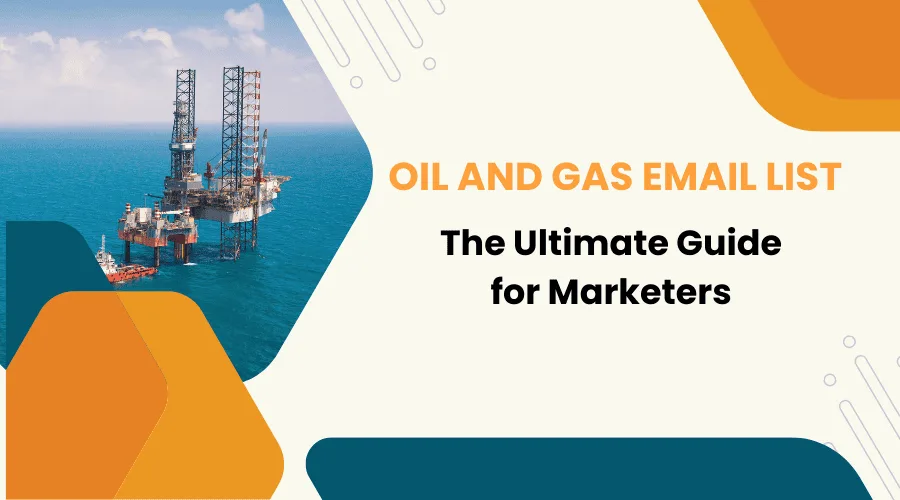
Quick answer: An oil and gas industry email list is a B2B contact database of decision makers at companies that explore for, produce, transport, refine, and service oil and natural gas. Records pair a business email with title, company, industry segment, NAICS code, company size, and location, so suppliers can reach operations, engineering, procurement, and executive buyers in the right part of the value chain.
This guide covers how the oil and gas industry is segmented, which roles buy, what a good database contains, how to compare providers, and how to run outreach to a technical, safety-focused audience.
Key takeaways
An oil and gas industry email list is a segmented database of professionals at operators, drilling contractors, oilfield service companies, pipeline operators, refiners, and related suppliers. It typically includes executives, operations and engineering managers, drilling and production leaders, health, safety, and environment (HSE) managers, and procurement staff, with company and location data.
You will also see it called an oil and gas mailing list, an oil and gas email database, or an energy industry contact list. Some energy lists also include utilities and renewables, so confirm the scope before you buy. Related audiences are covered in our guides to utilities and mining contacts.
For scale, the U.S. Bureau of Labor Statistics reports roughly 119,000 to 120,000 people employed in oil and gas extraction (NAICS 211) in late 2024, according to its Industries at a Glance profile. That figure excludes drilling contractors, support services, pipelines, and refining, which are classified separately.
| Segment | What it covers | Common NAICS codes | Typical buyers |
|---|---|---|---|
| Upstream | Exploration, drilling, and production of crude oil and natural gas | 211 (oil and gas extraction), 213111 (drilling oil and gas wells), 213112 (support activities) | Drilling and completions managers, production engineers, operations VPs |
| Midstream | Pipelines, gathering, processing, and storage | 486 (pipeline transportation) | Pipeline operations, integrity, and maintenance managers |
| Downstream | Refining and marketing of petroleum products | 324110 (petroleum refineries) | Refinery operations, maintenance, and turnaround managers |
| Oilfield services and suppliers | Equipment, chemicals, services, and engineering for the segments above | Varies, often 213112 and manufacturing codes | Sales, operations, and procurement leaders |
Using NAICS codes rather than free-text industry labels keeps your targeting consistent across providers and matches how government data classifies the industry.
For executive-level campaigns across industries, see our C-level executives email list guide.
| Field group | Typical fields | How it helps |
|---|---|---|
| Contact | Full name, business email, direct phone, LinkedIn profile URL | Reach technical buyers on more than one channel |
| Role | Job title, function, seniority | Separate engineers, HSE, procurement, and executives |
| Company | Company name, website, NAICS code, segment, employee range, revenue range | Target the right part of the value chain |
| Location | Headquarters and field office locations, state, basin or region where available | Focus on producing regions and service territories |
| Record quality | Last verified date, verification status | Plan re-verification before sends |
Example segments:
Access CampaignLake's Industry-Specific Email Database
For a structured comparison, use our provider audit checklist.
CampaignLake is a B2B data provider that builds custom contact lists for sales and marketing teams. Its oil and gas industry email list can be filtered by job title, industry segment, company size, and location. For adjacent energy markets, see its renewable energy industry list.
Request a sample built to your segment, check it against the criteria above, and compare it with other providers before you buy.
Explore CampaignLake's B2b Email Database
An oil and gas industry email list is a B2B database of decision makers at operators, drilling contractors, oilfield service companies, pipeline operators, and refiners. Records typically include business email, title, company, segment, NAICS code, company size, and location.
Upstream covers exploration, drilling, and production. Midstream covers pipelines, gathering, processing, and storage. Downstream covers refining and marketing of petroleum products. Each segment has different buyers, so most campaigns target one at a time.
Common codes include 211 for oil and gas extraction, 213111 for drilling oil and gas wells, 213112 for support activities, 486 for pipeline transportation, and 324110 for petroleum refineries.
BLS reported roughly 119,000 to 120,000 employees in oil and gas extraction (NAICS 211) in late 2024. Drilling contractors, support services, pipelines, and refining are counted separately, so the full industry workforce is larger.
Target the function that owns your product: engineering and operations for technical products, HSE managers for safety and environmental offers, maintenance and integrity managers for asset services, and procurement for vendor approval. Executives approve major contracts.
Not always. Energy lists may include utilities, renewables, and power generation alongside oil and gas. Confirm the segments and NAICS codes included before you buy.
In the United States, CAN-SPAM allows B2B commercial email without prior consent if you follow its rules, including honest headers and subject lines, a postal address, and a working opt-out. Other countries have their own rules. This is general information, not legal advice.
List providers usually deliver CSV or Excel files that import into most CRM and marketing automation tools.

David Jax is a seasoned B2B marketing strategist specializing in targeted email lists and data-driven outreach solutions. With years of experience in lead generation and sales enablement, David helps businesses connect with the right audiences through precision-based marketing tactics. His ability to translate complex data into clear, actionable strategies has made him a trusted voice in the B2B space. Outside of his writing, David is passionate about exploring emerging trends in marketing technology and refining techniques that maximize campaign performance. He regularly contributes to leading industry blogs and enjoys sharing insights that help marketers turn data into growth.