Follow us on :

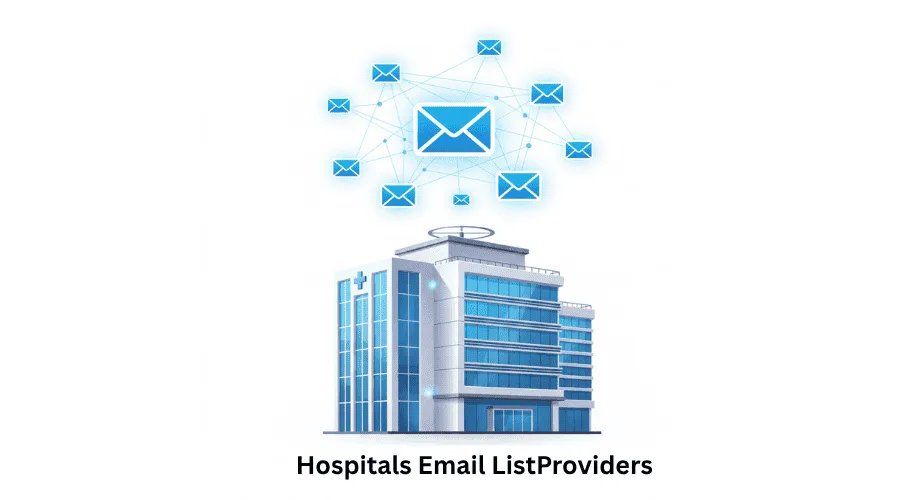
Quick answer: A hospital email list is a B2B contact database of hospitals and their decision makers, such as CEOs, CFOs, chief medical and nursing officers, IT leaders, department directors, and procurement managers, with hospital type, size, system affiliation, and location. Medical device makers, health IT vendors, staffing firms, and service providers use it to reach the people who approve hospital purchases.
This guide explains how U.S. hospitals are structured, who buys inside a hospital, what a hospital database should include, and how to approach long, committee-driven hospital sales.
Key takeaways
A hospital email list is a segmented database of hospitals and the executives, clinical leaders, and operational managers who run them. Records typically include hospital name, type, bed count where available, system affiliation, location, and contacts by role.
You will also see it called a hospital mailing list or a hospital email database. For guidance on engaging individual executives, see our guide to reaching hospital decision makers.
According to the American Hospital Association’s Fast Facts on U.S. Hospitals, 2026, based on its 2024 Annual Survey, there were about 6,100 hospitals in the United States. Of these, 5,121 were community hospitals, roughly 84% of the total, and 666 were nonfederal psychiatric hospitals.
Among community hospitals, the AHA reports that about 58% are nongovernment not-for-profit, 24% are investor-owned, and roughly two-thirds are affiliated with a health system. For B2B sellers, system affiliation is important because many purchasing decisions are made at the system level.
| Role | Typically responsible for | Relevant offers |
|---|---|---|
| CEO and executive team | Strategy, major capital projects, partnerships | Large technology platforms, consulting, capital equipment |
| CFO | Budgets, revenue cycle, financial systems | Revenue cycle services, financial software, cost reduction |
| Chief medical and nursing officers | Clinical quality, staffing, clinical standards | Clinical tools, staffing, quality programs |
| CIO and IT leaders | EHR, cybersecurity, IT infrastructure | Health IT, integrations, security |
| Department directors | Needs within radiology, surgery, laboratory, and other departments | Department-specific equipment and software |
| Procurement and supply chain | Contracts, vendor approval, group purchasing | All products, through approved vendor processes |
For IT-focused campaigns, see our guide to hospitals using Epic.
| Field group | Typical fields | How it helps |
|---|---|---|
| Hospital | Name, type (community, teaching, psychiatric, critical access), bed count where available | Match offers to hospital size and type |
| Ownership | Not-for-profit, investor-owned, government; health system affiliation | Identify central versus local buying |
| Contacts | Name, title, department, business email, phone | Reach each member of the buying group |
| Location | City, state, ZIP code, urban or rural | Plan territories and rural programs |
| Technology (where available) | EHR and major systems in use | Target integration and replacement opportunities |
Access CampaignLake's HealthCare Decision-Maker Database
Example segments:
CampaignLake is a B2B data provider that builds custom healthcare contact lists. Its hospitals email list and hospital decision makers list include role-specific lists for hospital CEOs, hospital CFOs, chief medical officers, and hospital procurement.
Request a sample for your hospital types and states, check it against hospital websites, and compare it with other providers before you buy.
Ready to Reach More Decision-Makers?
Access verified business decision-maker data worldwide. Filter, download and build targeted outreach lists in minutes—without manual scraping or guesswork.
A hospital email list is a B2B database of hospitals and their decision makers, including executives, clinical leaders, IT leaders, department directors, and procurement managers, with hospital type, size, system affiliation, and location.
The American Hospital Association’s Fast Facts on U.S. Hospitals, 2026 reports about 6,100 hospitals, including 5,121 community hospitals, based on its 2024 Annual Survey.
Hospital purchases usually involve a buying group: executives approve major investments, clinical and department leaders define needs, IT reviews technology, and procurement or supply chain teams manage contracts and vendor approval.
Often, yes. About two-thirds of community hospitals are affiliated with a health system, and many systems negotiate contracts centrally for their hospitals.
Yes. Most providers let you filter hospitals by type, bed count, ownership, system affiliation, and location.
In the United States, CAN-SPAM allows B2B commercial email without prior consent if you follow its rules. Never include patient information in marketing. This is general information, not legal advice.
Hospital sales cycles are often long because of committee reviews, budget cycles, and vendor approval processes. Plan for multiple touches across the buying group.
Re-verify before each major campaign. Hospital executives and department leaders change roles, and health systems merge and restructure.

Tanoj Kumar writes the CampaignLake blog's guides on B2B data, industry and professional email lists, and B2B lead generation.