Follow us on :

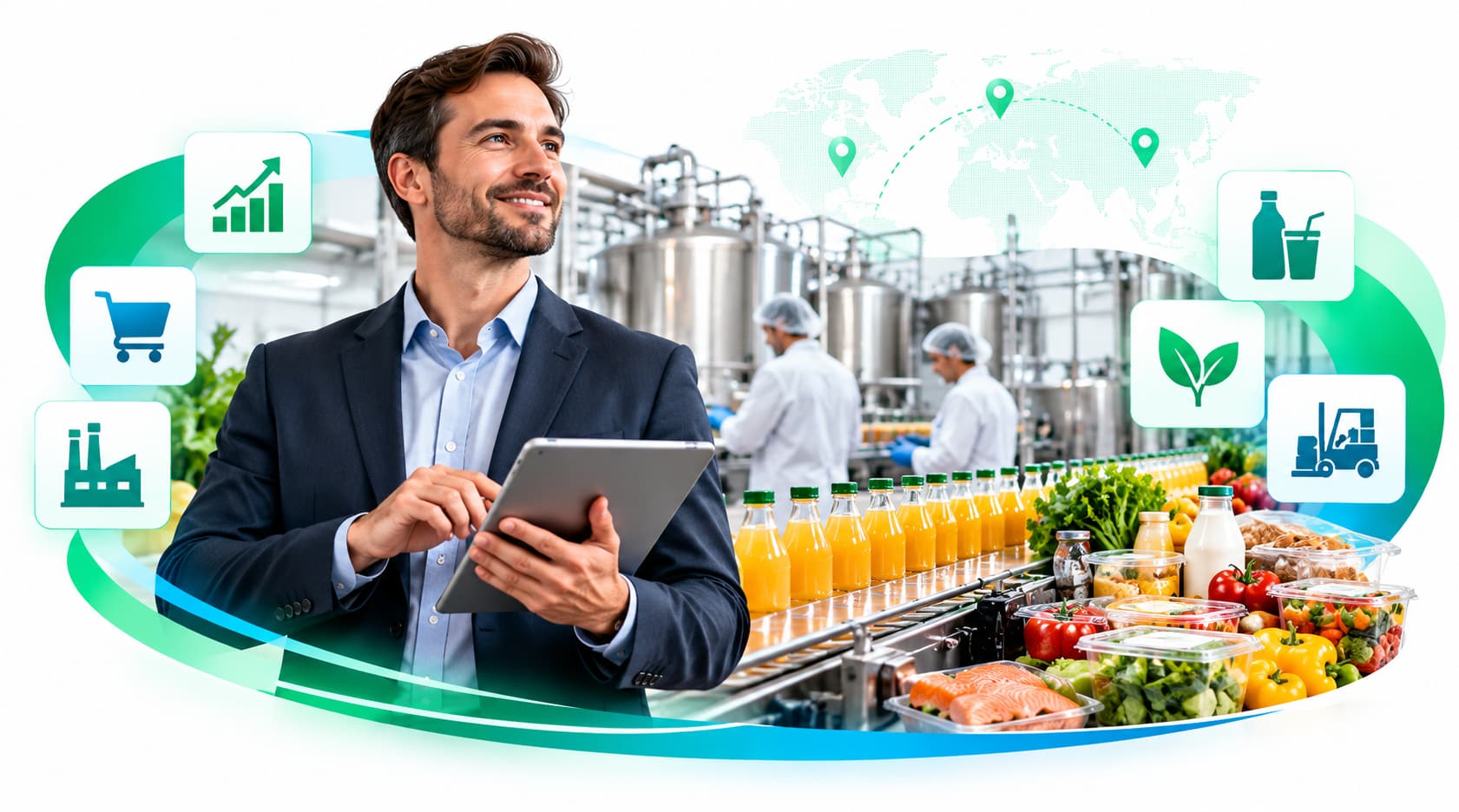
Finding companies in the food and beverage industry is relatively easy.
Finding the right person inside those companies is much harder.
A food manufacturer may have procurement teams, plant managers, operations executives, quality leaders, food-safety specialists, R&D professionals, supply-chain managers, finance teams, and C-level executives—all potentially involved in different purchasing decisions.
That is why a broad contact database is rarely enough.
A Food and Beverage Industry Email List gives B2B sales and marketing teams a more structured way to identify food and beverage companies, segment them by market and company characteristics, and connect with relevant business decision-makers.
The opportunity is significant. In the United States, food manufacturing is classified under NAICS 311, while beverage manufacturing is part of NAICS 312. The U.S. Bureau of Labor Statistics reported roughly 1.76 million employees in food manufacturing in August 2026, illustrating the scale and diversity of the sector.
But the goal isn’t to collect the largest possible number of contacts.
The goal is to identify the companies and people most likely to matter to your business.
This guide explains how to find, segment, verify, and use food and beverage decision-maker data for B2B prospecting, account-based marketing, sales development, and lead generation.
A Food and Beverage Industry Email List is a targeted B2B database containing business contact and company information for professionals and organizations operating across the food and beverage ecosystem.
Depending on the provider and dataset, records can include:
The most useful lists are not simply large collections of email addresses.
They allow marketers and sales teams to answer three important questions:
Which companies should we target?
Which people influence the buying decision?
Why are those people relevant to our product or service?
That distinction turns an ordinary contact file into a more useful prospecting resource.
The food and beverage industry is not a single homogeneous market.
The U.S. Census Bureau separates food manufacturing under NAICS 311 and beverage manufacturing under NAICS 312, with food manufacturing spanning categories such as animal food, dairy, meat, seafood, bakery, snack, fruit and vegetable processing, and other food products. Beverage manufacturing includes areas such as soft drinks, water, alcoholic beverages, and distilled beverages.
That means the buyer for one company can be completely different from the buyer for another.
For example:
A packaging supplier may need to reach procurement and plant operations.
A food-safety software company may need quality and food-safety leaders.
An industrial equipment manufacturer may need plant managers and operations directors.
A marketing agency may need CMOs, marketing directors, brand leaders, or founders.
A logistics company may need supply-chain and distribution executives.
The right database therefore begins with the buyer, not merely the industry.
One of the biggest mistakes in B2B prospecting is assuming that every purchasing decision is made by the CEO.
In food and beverage organizations, different departments can own different buying decisions.
Here are some of the most relevant decision-maker groups to consider.
Depending on your offer, executive-level contacts can include:
Executives are particularly relevant for strategic solutions, technology investments, major operational changes, consulting services, financial products, and enterprise-level partnerships.
For products and services connected to sourcing and purchasing, consider:
These contacts can be especially relevant for suppliers of ingredients, packaging, equipment, MRO products, logistics, and other operational inputs.
For industrial products and operational solutions, target roles such as:
These roles can be highly relevant when the product affects production capacity, efficiency, automation, maintenance, equipment, safety, or plant performance.
Food safety and quality are specialized functions.
Potential contacts include:
For software, testing, certification, compliance, laboratory, traceability, or quality-management solutions, these contacts may be more relevant than general executives.
Companies selling ingredients, technology, formulation solutions, laboratory products, or innovation services may want to reach:
Relevant roles may include:
These roles are particularly relevant for logistics, warehousing, cold-chain, transportation, inventory, forecasting, and supply-chain technology providers.
Digital transformation is increasingly relevant to manufacturing and food businesses.
Depending on your solution, consider:
The important principle is simple:
Don’t target job titles because they sound senior. Target them because they influence the problem your product solves.
Access CampaignLake's Industry-Specific Email Database
A strong Food and Beverage Email List should allow segmentation beyond the broad “food and beverage” label.
Potential target segments include:
This segmentation is important because a prospecting campaign becomes significantly more relevant when the audience reflects the actual market you are trying to sell into.
A contact count alone tells you very little about database quality.
Before using a Food and Beverage Email List, evaluate the depth and usefulness of the underlying records.
Important fields can include:
| Data Field | Why It Matters |
|---|---|
| Full Name | Enables personalized outreach |
| Business Email | Primary email communication channel |
| Job Title | Helps identify decision-makers |
| Company Name | Enables account-level targeting |
| Website | Supports prospect research |
| Industry | Identifies market segment |
| Sub-Industry | Enables more precise targeting |
| Job Function | Connects contacts to business responsibilities |
| Company Size | Helps define your ICP |
| Revenue Range | Supports account prioritization |
| Location | Enables geographic campaigns |
| Phone | Supports sales follow-up |
| Industry Code | Helps create structured segments |
| LinkedIn Profile | Supports multichannel prospecting |
The exact fields you need should depend on your sales strategy.
If you’re selling plant equipment, facility and operations information may matter more than marketing data.
If you’re selling marketing software, marketing leadership and company growth characteristics may matter more.
If you’re selling procurement technology, purchasing and supply-chain functions become more important.
The strongest prospecting databases begin with an Ideal Customer Profile rather than a random collection of contacts.
Start with:
Industry → Company type → Geography → Company size → Revenue → Job function → Job title
For example:
U.S. food manufacturers with 100–1,000 employees, targeting procurement and operations leaders.
That is much more actionable than:
Food companies in the United States.
Identify companies that match your ICP.
Useful filters may include:
Once you know the companies, identify the people who influence the purchase.
A single target account may contain several potentially relevant stakeholders.
For example:
Target account: Food manufacturer
Potential contacts:
Before outreach, evaluate the quality of the data.
Look for:
Don’t send the same message to every contact.
Create segments based on buying relevance.
The same database can support completely different campaigns.
A procurement manager might receive a message about cost savings.
A plant manager might receive a message about production efficiency.
A quality director might receive a message about compliance or quality control.
The database identifies the audience. Your message creates the reason to respond.
Segmentation is one of the most important steps in turning contact data into a usable prospecting strategy.
Separate:
Create groups for:
For example:
Small businesses
Mid-market companies
Enterprise organizations
A product designed for large manufacturing plants should not necessarily be promoted using the same message as a solution designed for small food brands.
You can create campaigns by:
Revenue can help sales teams prioritize accounts according to potential commercial value.
This is one of the most valuable segmentation methods.
Instead of asking:
“Who works at this company?”
Ask:
“Who can influence, approve, implement, or benefit from this purchase?”
That creates a much more meaningful prospecting audience.
Here are practical examples of how different B2B companies could use the same market differently.
Target companies: Food manufacturers
Target roles: Procurement Manager, Purchasing Director, Plant Manager
Geography: United States
Company size: Mid-market and enterprise
The messaging can focus on packaging efficiency, sourcing, production requirements, or supply reliability.
Target companies: Food manufacturers and processors
Target roles: Quality Director, QA Manager, Food Safety Manager
Messaging: Quality processes, compliance workflows, traceability, or operational visibility.
Target companies: Food processing and manufacturing companies
Target roles: Plant Manager, Operations Director, Manufacturing Director
Messaging: Production efficiency, equipment performance, downtime reduction, or plant operations.
Target companies: Food and beverage brands
Target roles: CMO, VP Marketing, Marketing Director, Founder
Messaging: Brand growth, customer acquisition, ecommerce, content, or demand generation.
The lesson is important:
One industry can contain dozens of different buying audiences.
A targeted database can support several stages of the sales and marketing process.
Faster Prospect Research: Sales teams can start with a defined audience instead of manually searching for every company and contact.
More Precise Targeting: Industry, company, geography, and job-title filters can help narrow a broad market into a more relevant audience.
Account-Based Marketing: A database can help sales and marketing teams identify multiple stakeholders within target accounts.
Market Expansion: Companies entering a new geographic or industry segment can use structured contact data to build an initial prospect universe.
Outbound Sales: Business development teams can use targeted contact data as an input to prospecting sequences.
Lead Generation: Marketing teams can segment prospects around specific products, industries, company characteristics, and buyer roles.
But there is an important distinction:
A database does not generate qualified leads by itself.
Lead generation depends on the entire system:
Targeting + Data Quality + Offer + Messaging + Deliverability + Follow-Up + Sales Execution
The database is one part of that system.
Account-based marketing works particularly well when your sales process involves identifiable target accounts and multiple stakeholders.
A practical workflow looks like this:
Identify companies that match your ICP.
Find relevant stakeholders across departments.
Group them by role and buying responsibility.
Make the communication relevant to the company’s situation.
Email can be combined with sales calls, LinkedIn activity, content, webinars, events, and other appropriate channels.
Identify which accounts and contacts are showing meaningful interest.
Move qualified opportunities toward direct sales conversations.
For example, a food equipment company could identify 500 target manufacturers and map several operational stakeholders within each account rather than sending one generic message to an enormous database.
That is the difference between contact-volume marketing and account-focused prospecting.
One of the biggest mistakes in email prospecting is treating every contact as identical.
A procurement executive and a food-safety manager may work at the same company but have completely different priorities.
Instead, personalize around:
For example:
We help companies improve their business with our innovative solution.
We work with food manufacturers looking to improve procurement visibility across multiple production facilities.
The second message gives the recipient a reason to consider why the message applies to them.
Good personalization is not simply adding someone’s first name.
It is making the message relevant to the person’s business responsibility.
Data quality directly affects the usefulness of a prospecting campaign.
Before using a database, evaluate whether records are:
Email-Valid: The email address should be checked for validity before use.
Company-Valid: The organization should exist and fit your target market.
Role-Relevant: The person’s job title should align with your campaign.
Current: Job changes and company changes can make previously accurate records outdated.
Duplicate-Free: Duplicate contacts can distort campaign performance and waste outreach capacity.
Appropriately Segmented: The list should match the audience you actually intend to reach.
The best provider is not necessarily the one with the largest number of records.
A smaller, highly relevant dataset can be more useful than a massive, poorly targeted database.
Before purchasing or using a Food and Beverage Email List, ask these questions:
1. How Is the Data Verified?
Look for a clear explanation of the provider’s verification methodology.
2. How Fresh Is the Data?
Ask when records were last updated and how stale records are handled.
3. Can You Target Job Titles?
If you cannot isolate the people who influence your purchase, the database may be too broad.
4. Can You Segment by Sub-Industry?
Food manufacturing and beverage distribution are not the same audience.
5. Can You Filter by Geography?
Geographic targeting can be essential for territory-based sales teams.
6. Can You Filter by Company Size or Revenue?
This helps align the dataset with your ICP.
7. Can You Preview Sample Records?
A credible provider should make it possible to evaluate the data before making a major purchase.
8. Is the Data CRM-Ready?
Structured CSV or Excel delivery can simplify the process of moving records into your sales and marketing systems.
9. Does the Provider Explain Its Compliance Approach?
Compliance should be considered before launching any direct marketing campaign.
10. Can the Audience Be Customized?
A custom audience built around your ICP is generally more useful than an undifferentiated industry export.
A general B2B database can be useful for broad market research.
A specialized Food and Beverage Email List is designed around a narrower market.
| Factor | General B2B Database | Specialized Food & Beverage List |
|---|---|---|
| Industry targeting | Broad | Industry-specific |
| Sub-industry targeting | Variable | More focused |
| Buyer-role targeting | General | Food & beverage-specific |
| Procurement targeting | Broad | More relevant |
| Plant/operations roles | Variable | More relevant |
| Food-safety roles | Limited | Specialized |
| ABM targeting | Possible | More focused |
| Campaign personalization | Moderate | More contextual |
The right choice depends on your objective.
If you’re testing several unrelated industries, a broad database may make sense.
If food and beverage is your ICP, specialized targeting can reduce irrelevant records and make campaign planning easier.
Even a high-quality database can underperform when the strategy is weak.
Avoid these mistakes.
More contacts do not automatically mean more opportunities.
A 500-person company does not mean you should contact all 500 employees.
The right company with the wrong contact can still produce a poor prospect.
Procurement, operations, QA, IT, and marketing leaders have different priorities.
People change jobs. Companies change structures. Domains change.
Industry relevance alone is not enough.
Commercial email has legal and operational requirements that vary by market.
The list is an input.
Your targeting, offer, message, sending practices, follow-up, and sales process determine what happens next.
A targeted database should never be treated as a substitute for understanding applicable marketing laws.
In the United States, the FTC states that CAN-SPAM applies to commercial email, including business-to-business messages. Requirements include accurate header information, non-deceptive subject lines, identification of commercial messages, a valid physical postal address, and a clear mechanism for opting out of future marketing emails.
Requirements can differ in other markets.
For example, UK rules under PECR distinguish between corporate subscribers and certain individual subscribers, and the ICO notes that B2B electronic marketing rules depend on the type of business and communication involved.
The ICO also emphasizes responsible direct marketing practices, including planning how personal information is used, having an appropriate lawful basis where required, collecting information fairly, and respecting objections and opt-outs.
Therefore, before launching a campaign:
Data quality and compliance are separate questions. A verified email address does not automatically mean that any particular marketing use is lawful.
For companies that need a targeted B2B audience, CampaignLake provides a way to build prospect datasets around specific industry and buyer criteria rather than relying on one broad audience.
CampaignLake’s Food and Beverage Industry Email List can be positioned around criteria such as:
The objective is straightforward:
Help sales and marketing teams find the companies and decision-makers that fit their Ideal Customer Profile.
Instead of asking:
“How many food and beverage contacts do we have?”
A better question is:
“How many relevant food and beverage decision-makers match our exact ICP?”
That shift—from database size to buyer relevance—is what makes industry-specific prospecting more valuable.
Want to turn a database into an actual pipeline-building strategy?
Start with these campaign ideas.
Audience: Procurement and purchasing leaders at food manufacturers.
Offer: Cost, sourcing, supply, or procurement-related solution.
Audience: Plant managers and operations directors.
Offer: Equipment, automation, maintenance, productivity, or operational technology.
Audience: QA and food-safety leaders.
Offer: Compliance, testing, traceability, monitoring, or food-safety technology.
Audience: Supply-chain and logistics executives.
Offer: Transportation, inventory, warehousing, cold-chain, or logistics solutions.
Audience: CMOs, marketing directors, and brand leaders at food and beverage companies.
Offer: Demand generation, digital marketing, ecommerce, advertising, or customer acquisition.
Audience: CIOs, CTOs, IT directors, and digital transformation leaders.
Offer: ERP, cybersecurity, analytics, automation, AI, or digital transformation.
Audience: Target companies in a new geographic region.
Offer: A market-specific product or service designed around the needs of that territory.
Each campaign starts with the same principle:
Right company + right person + relevant problem + relevant message.
B2B companies selling products or services to food and beverage organizations can use targeted industry data for sales prospecting, account-based marketing, market expansion, demand generation, and other business development activities.
Relevant decision-makers can include CEOs, procurement managers, purchasing directors, plant managers, operations directors, quality leaders, food-safety managers, supply-chain executives, R&D leaders, IT executives, and marketing leaders. The best role depends on the product or service being sold.
Useful fields can include business email addresses, names, job titles, company names, websites, industry classifications, company size, revenue range, location, phone numbers, job functions, and other firmographic information relevant to prospect qualification.
Common segmentation criteria include food versus beverage, sub-industry, job function, job title, company size, revenue, geography, business model, and buying responsibility. The strongest segmentation strategy starts with your Ideal Customer Profile.
Verification can involve checking email syntax, domain validity, mailbox status, company affiliation, duplicate records, and role relevance. Data should also be reviewed and refreshed periodically because professional information changes over time.
Yes. A specialized database can help sales and marketing teams identify target accounts, map multiple stakeholders, segment contacts by buying role, and coordinate account-specific outreach.
There is no universal refresh interval that guarantees accuracy. The appropriate cadence depends on the provider’s methodology, market, data sources, and rate of change. Ask providers how they detect job changes, company changes, invalid emails, duplicates, and other stale records.
No. Data quality and marketing compliance are separate issues. Applicable laws vary by jurisdiction, audience, communication method, and circumstances. In the United States, CAN-SPAM applies to commercial B2B email; other jurisdictions can impose additional requirements.
Yes. Requesting sample records is a practical way to evaluate whether a provider’s data matches your required industries, job titles, locations, company sizes, and other ICP criteria before committing to a larger dataset.
Pricing depends on factors such as contact volume, segmentation, specialty, geography, data fields, verification, enrichment, freshness, and delivery format. Requesting a sample and comparing the usable data quality can be more informative than comparing price alone.
Yes. A customized segment can be built around criteria such as province, city, specialty, healthcare organization type, job title, seniority, or other available business attributes.
The food and beverage industry is too diverse for a one-size-fits-all prospecting strategy.
A beverage manufacturer, food processor, restaurant group, packaging supplier, ingredient company, and food technology business can all have completely different buying committees.
That is why the most effective approach isn’t simply:
Find more contacts.
It is:
Find the right companies.
Identify the right decision-makers.
Segment them according to buying responsibility.
Verify the information.
Personalize the outreach.
Follow applicable marketing and privacy requirements.
And most importantly:
Build your audience around the problem you solve—not simply the industry you want to sell into.
If your target market includes food manufacturers, beverage companies, processors, distributors, foodservice organizations, or other food and beverage businesses, a well-segmented Food and Beverage Industry Email List can give your sales and marketing teams a structured starting point for building a more focused B2B pipeline.
The objective isn’t a bigger database. It’s a better-qualified audience.
Ready to Reach More Decision-Makers?
Access verified business decision-maker data worldwide. Filter, download and build targeted outreach lists in minutes—without manual scraping or guesswork.

Tanoj Kumar writes the CampaignLake blog's guides on B2B data, industry and professional email lists, and B2B lead generation.