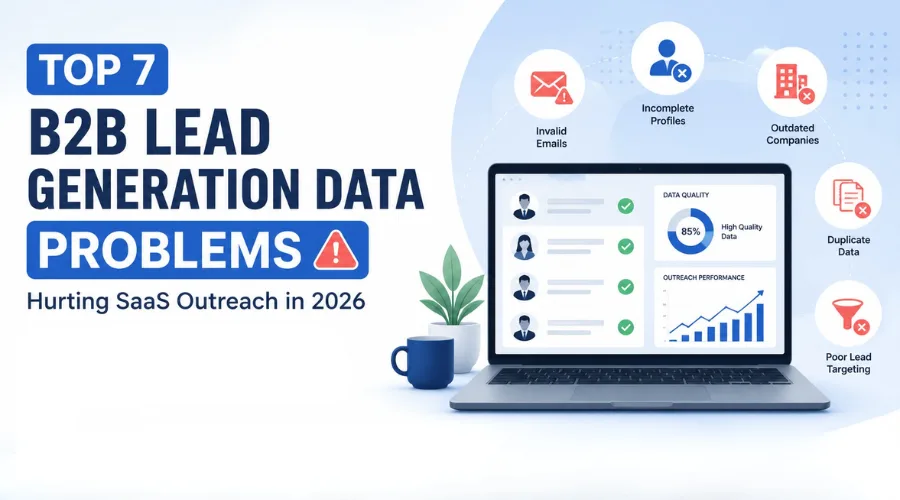
Top 7 B2B Lead Generation Data Problems Hurting SaaS Outreach in 2026

Home Informative Top 7 B2B Lead Generation Data Problems Hurting SaaS Outreach in 2026
B2B Lead Generation Data
Table of Contents

Successful SaaS lead generation starts with accurate B2B Lead Generation Data. Even the best B2B marketing and email marketing campaigns can underperform if they’re built on outdated contacts, incomplete prospect information, or inaccurate B2B contact databases. Poor data quality often results in higher bounce rates, lower response rates, and missed sales opportunities.

In 2026, reliable B2B Lead Generation Data is essential for scaling outreach and generating qualified leads. Verified contact data, sales intelligence, and data enrichment help businesses improve ICP targeting, connect with decision-makers, and boost pipeline generation. In this article, we’ll cover the seven biggest data challenges affecting SaaS outreach and how to overcome them for better campaign performance and growth.

What is a Lead Generation Data?

B2B Lead Generation Data refers to the collection of verified business information that helps companies identify, qualify, and connect with potential customers. Rather than relying on guesswork, businesses use this data to target organizations and decision-makers that fit their Ideal Customer Profile.

Here are common data fields included in a B2B Lead Generation Data database:

  • Full Name
  • Job Title
  • Business Email Address
  • Direct Phone Number
  • Company Name
  • Industry
  • Company Size (Employee Count)
  • Annual Revenue
  • Location (City, State, Country)
  • Company Website
  • LinkedIn Profile
  • Technology Stack / Intent Data

Why B2B Lead Generation Data Matters for SaaS Companies

For SaaS businesses, data quality directly impacts revenue performance.

  • Improves Lead Qualification: Accurate data helps sales teams identify prospects matching their ideal customer profile. This allows SDRs to focus on qualified opportunities instead of wasting time on irrelevant contacts.
  • Increases Email Deliverability: A verified email database reduces invalid addresses and improves sender reputation. Lower bounce rates help businesses maintain better email deliverability.
  • Supports Account-Based Marketing: ABM campaigns require detailed account information. Enriched B2B contact databases help marketers identify key stakeholders and create personalized campaigns.
  • Enhances CRM Data Quality: CRM enrichment keeps customer and prospect records accurate, complete, and updated. This improves reporting, forecasting, and revenue operations.
  • Enables Scalable Outreach: With reliable prospecting data, SaaS companies can expand outbound campaigns without sacrificing targeting accuracy. 

Top 7 B2B Lead Generation Data Problems Hurting SaaS Outreach

Poor-quality data can slow down even the best SaaS sales teams. Outdated contacts and inaccurate prospect details hurt outreach and pipeline growth. Here’s a quick look at the top seven B2B Lead Generation Data problems affecting SaaS outreach in 2026 and how to fix them.

Problem #1: Poor Contact Accuracy Reduces Outreach Results

One of the biggest obstacles to successful SaaS outreach is inaccurate contact information. Business data changes constantly as professionals switch jobs, companies expand into new markets, departments restructure, and decision-makers take on new responsibilities.

This natural process of data decay means that even a recently acquired database can lose accuracy within a matter of months if it isn’t regularly maintained.

Common issues include:

  • Invalid business email addresses
  • Outdated phone numbers
  • Employees who have left the company
  • Incorrect job titles
  • Company mergers or acquisitions
  • Business closures
  • Duplicate contact records


For SaaS companies running outbound campaigns, even a small percentage of inaccurate records can significantly reduce campaign performance.

How It Impacts SaaS Outreach

Poor contact accuracy often results in:

  • High bounce rates
  • Lower sender reputation
  • Reduced email deliverability
  • Lower response rates
  • Missed opportunities with decision-makers
  • Wasted SDR productivity
  • Increased outreach costs


For example, if your SDR team spends half the day calling disconnected numbers or emailing inactive accounts, valuable selling time is lost, reducing the efficiency of your outbound program. 

How to Solve It

Businesses should adopt a continuous data quality strategy by:

  • Performing regular email verification
  • Updating contact records monthly or quarterly
  • Removing duplicate and inactive records
  • Using verified business email databases
  • Partnering with trusted B2B data providers that maintain continuously refreshed databases


Providers like CampaignLake help businesses reduce these challenges by offering human-verified, regularly updated contact databases that improve campaign performance and support scalable outbound growth. 

2. Poor ICP Targeting

Even with accurate contact information, outreach campaigns can fail if businesses target the wrong audience. Many SaaS companies make the mistake of casting a wide net instead of focusing on their Ideal Customer Profile (ICP).

Without clear ICP targeting, marketing and sales teams often spend time engaging companies that lack the budget, authority, or need for their solution.

Common targeting mistakes include:

  • Reaching out to the wrong job roles
  • Targeting businesses outside the ideal industry
  • Ignoring company size and revenue filters
  • Overlooking technology stack compatibility
  • Failing to identify buying committees


These mistakes reduce conversion rates and increase customer acquisition costs.

Why ICP Targeting Matters

Effective ICP targeting helps businesses:

  • Improve lead qualification
  • Increase meeting booking rates
  • Personalize messaging
  • Shorten sales cycles
  • Generate higher-quality pipeline
  • Improve account-based marketing campaigns


A well-defined ICP typically considers:

  • Industry
  • Company size
  • Annual revenue
  • Geographic location
  • Technology stack
  • Growth stage
  • Decision-maker roles
  • Purchase intent
  • Solution


To improve targeting accuracy:

  • Build detailed ICPs using historical customer data.
  • Use firmographic and technographic filters to narrow your audience.
  • Incorporate intent signals to prioritize accounts actively researching solutions.
  • Regularly refine target lists based on campaign performance.


Working with a data provider that offers advanced segmentation and enriched company profiles can significantly improve outreach precision and campaign ROI.

3. Missing Data Enrichment

Having only a name and email address is no longer enough to run successful SaaS outreach campaigns. Buyers expect personalized communication that demonstrates an understanding of their business, challenges, and goals.

Without data enrichment, sales teams lack the context needed to create relevant conversations.

Incomplete records often miss critical information such as:

  • Direct phone numbers
  • LinkedIn profile URLs
  • Department information
  • Company revenue
  • Employee count
  • Technologies used
  • Funding status
  • Seniority level
  • Decision-making authority


As a result, SDRs spend additional time researching prospects instead of engaging them.

Why Missing Data Hurts Outreach

Incomplete records lead to:

  • Generic email campaigns
  • Poor personalization
  • Lower engagement rates
  • Longer prospect research time
  • Lower sales productivity
  • Reduced conversion rates


In competitive SaaS markets, personalized outreach consistently outperforms mass messaging. Rich prospect profiles enable sales teams to tailor conversations based on company size, technology adoption, industry challenges, and business priorities.

Solution

Implement a robust data enrichment strategy by:

  • Enhancing existing CRM records with firmographic and technographic data.
  • Appending missing contact details through trusted data sources.
  • Adding LinkedIn URLs, direct dials, and company insights.
  • Enriching records with buyer intent and organizational information.
  • Keeping enriched data synchronized across your CRM and sales engagement platforms.


Comprehensive enrichment transforms basic contact lists into actionable sales intelligence, enabling more relevant conversations, better lead qualification, and stronger pipeline generation.

Access CampaignLake's Industry-Specific Email Database

Find verified decision-makers across healthcare, technology, finance, manufacturing and more.

4. Low Email Deliverability Due to Poor Data Hygiene

Even the most compelling outreach message will fail if it never reaches your prospect’s inbox. One of the most overlooked issues in SaaS outreach is poor data hygiene, which directly impacts email deliverability and campaign performance.

As businesses scale their outbound efforts, contact databases inevitably accumulate outdated, duplicate, or invalid records. Without regular maintenance, these issues can quickly damage your sender reputation and reduce the effectiveness of your email campaigns.

Common data hygiene issues include:

  • Invalid or inactive email addresses
  • Duplicate contact records
  • Role-based email addresses (e.g., info@, support@)
  • Disposable email accounts
  • Spam trap addresses
  • Unverified third-party contacts
  • Outdated company information


Over time, these problems increase bounce rates and make it harder for legitimate emails to reach decision-makers.

How Poor Data Hygiene Impacts SaaS Outreach

Poor database quality creates a ripple effect across your entire outbound strategy.

Key consequences include:

  • Higher email bounce rates
  • Reduced inbox placement
  • Lower open and reply rates
  • Poor sender reputation
  • Increased risk of domain blacklisting
  • Lower campaign ROI
  • Reduced sales productivity


For SaaS businesses sending thousands of outreach emails each month, even a small increase in bounce rates can significantly reduce pipeline generation. 

Best Practices to Improve Email Deliverability

Maintaining a clean database should be an ongoing process rather than a one-time task.

Best practices include:

  • Verify every email address before launching campaigns.
  • Remove inactive and bounced contacts regularly.
  • Eliminate duplicate records across CRM systems.
  • Monitor sender reputation and bounce rates.
  • Validate newly acquired contacts before importing them.
  • Refresh contact databases quarterly or monthly.
  • Use a verified email database from trusted providers.


Businesses that prioritize email verification and database maintenance consistently experience better deliverability, stronger engagement, and higher conversion rates.

5. No Intent Data for Prioritizing Buyers

Not every prospect is ready to buy. Treating every lead the same often wastes sales time and reduces conversions.

Modern SaaS sales teams use intent data to identify companies actively researching solutions like theirs. Without these insights, SDRs may spend time on low-priority accounts while high-intent buyers engage with competitors.

What Is Intent Data?

Intent data reveals buying signals that indicate a company may be preparing to purchase.

These signals include:

  • Product comparison research
  • Industry content consumption
  • Website engagement
  • Technology evaluation
  • Search behavior
  • Webinar participation
  • Whitepaper downloads
  • Software review activity


Combining first-party data with reliable third-party data gives sales teams a clearer understanding of buyer readiness.

Why Intent Data Matters

Intent-driven prospecting helps businesses:

  • Prioritize high-value accounts
  • Improve lead qualification
  • Increase response rates
  • Personalize outreach
  • Shorten sales cycles
  • Strengthen account-based marketing
  • Improve pipeline efficiency


Instead of contacting every prospect, sales teams can focus on companies already showing buying intent.

How to Use Intent Data Effectively

  • Combine intent signals with firmographic filters.
  • Align intent scoring with your Ideal Customer Profile (ICP).
  • Route high-intent leads directly to SDRs.
  • Personalize outreach based on buying behavior.
  • Continuously monitor intent signals.


When combined with sales intelligence and enriched prospect data, intent data helps generate a stronger, more qualified pipeline.

6. Fragmented CRM and Sales Data

Many SaaS companies use multiple sales and marketing tools. Without proper integration, customer information becomes fragmented across CRMs, marketing platforms, outreach tools, and spreadsheets.

Common issues include:

  • Duplicate contacts
  • Conflicting company information
  • Missing activity history
  • Inconsistent job titles
  • Outdated opportunity records
  • Manual data entry errors


This makes it difficult for sales teams to access a complete view of each prospect.

Business Impact

Disconnected data affects every revenue team.

Sales teams struggle to:


Marketing teams experience:

  • Poor segmentation
  • Duplicate campaigns
  • Inaccurate reporting
  • Lower campaign ROI


Revenue operations teams face:

  • Unreliable forecasting
  • Poor pipeline visibility
  • Inconsistent reporting


Ultimately, fragmented data slows decision-making and reduces productivity.

Solution: CRM Enrichment and Data Synchronization

Improve data consistency by:

  • Performing regular CRM enrichment
  • Synchronizing sales and marketing platforms
  • Standardizing data fields
  • Removing duplicate records
  • Automating contact updates
  • Conducting regular CRM audits


Partnering with trusted B2B data providers that deliver CRM-ready data helps improve data quality and operational efficiency.

7. Compliance Risks from Poor Data Management

As privacy regulations continue to evolve, compliance has become an essential part of B2B lead generation. Poor data management can lead to legal risks, damaged brand reputation, and declining customer trust.

Many businesses purchase outdated or non-compliant contact lists without verifying how the data was collected.

Common Compliance Challenges

Businesses often face:

  • Incomplete consent records
  • Outdated contact information
  • Poor data governance
  • Unverified third-party databases
  • Poor suppression list management
  • Inadequate record-keeping


These issues increase compliance risks during outbound campaigns.

Why Compliance Matters

Following GDPR compliance and CAN-SPAM compliance guidelines helps businesses:

  • Build customer trust
  • Reduce legal risks
  • Improve sender reputation
  • Support ethical marketing
  • Protect customer privacy
  • Strengthen long-term brand credibility


Compliance is not only a legal requirement but also a key factor in successful outbound marketing.

Best Practices for Compliance

  • Partner with reputable B2B data providers
  • Verify how contact data is sourced
  • Maintain updated suppression lists
  • Honor opt-out requests promptly
  • Review privacy policies regularly
  • Train teams on compliance requirements
  • Keep accurate data processing records


Choosing a provider that prioritizes compliance and transparent data collection helps businesses scale outreach while minimizing regulatory risk.

How High-Quality B2B Lead Generation Data Improves SaaS Outreach

High-quality B2B Lead Generation Data helps SaaS companies connect with the right prospects, improve outreach efficiency, and drive better results.

  • Improves email deliverability by reducing bounce rates and reaching the right inboxes
  • Enhances targeting by identifying companies that match the ideal customer profile
  • Generates more qualified leads with accurate and enriched data
  • Boosts sales productivity by reducing time spent on research
  • Supports better personalization for more relevant outreach
  • Accelerates pipeline growth with higher conversion opportunities
  • Improves marketing ROI by minimizing wasted efforts and increasing campaign effectiveness 

Why CampaignLake Is the Trusted Choice for B2B Lead Generation Data

Choosing the right data provider is just as important as choosing the right outreach strategy. Even the best sales teams and marketing campaigns depend on accurate, up-to-date, and compliant B2B Lead Generation Data to generate qualified pipeline and drive consistent revenue growth. 

Why Businesses Choose CampaignLake

  • Verified B2B Contact Database – Access accurate business emails, direct dials, company information, and decision-maker contacts.
  • Advanced ICP Targeting – Build highly targeted prospect lists using filters such as industry, job title, company size, revenue, location, and technology stack.
  • Comprehensive Data Enrichment – Enhance your CRM with firmographic, technographic, and professional insights for better personalization.
  • High Contact Accuracy – Regular verification and database updates help reduce bounce rates and improve email deliverability.
  • CRM-Ready Data – Easily integrate enriched contact data into your CRM and sales engagement platforms for faster outreach.
  • GDPR & CAN-SPAM Compliant – Data is managed with compliance best practices to support responsible and compliant B2B marketing.
  • Industry-Specific B2B Databases – Access targeted contact lists across industries including SaaS, healthcare, finance, manufacturing, technology, retail, construction, and more.

Ready to Reach More Decision-Makers?

Access the largest verified decision-maker email database in the U.S. Filter, download and launch targeted outreach in minutes – no scraping, no guesswork, no bounces.

Conclusion

High-quality B2B Lead Generation Data is the foundation of successful SaaS outreach. By addressing common challenges such as outdated contacts, poor targeting, missing data enrichment, and compliance risks, businesses can improve email deliverability, generate more qualified leads, and build a stronger sales pipeline. Partnering with a trusted provider like CampaignLake ensures your sales team always has accurate, verified, and actionable data to drive consistent growth.

Ready to improve your SaaS outreach? Contact CampaignLake today for verified B2B Lead Generation Data and start connecting with the right decision-makers faster. 

Frequently Asked Questions

1. What is B2B lead generation data?
B2B lead generation data is verified business information used to identify and reach potential customers. It typically includes company names, decision-maker contacts, business email addresses, phone numbers, job titles, and firmographic data to support targeted sales and marketing campaigns.
2. Why is accurate B2B lead generation data important?
Accurate B2B Lead Generation Data helps SaaS companies reach the right decision-makers, reduce bounce rates, improve email deliverability, and generate more qualified leads.
3. How often should B2B contact databases be updated?
B2B contact databases should be updated monthly or quarterly to reduce data decay and maintain contact accuracy. Regular updates improve outreach performance, email deliverability, and campaign ROI.
4. What causes poor email deliverability in B2B outreach?
Poor email deliverability is often caused by outdated email addresses, duplicate contacts, invalid records, and unverified databases. Regular email verification and database cleaning help improve inbox placement and reduce bounce rates.
5. How does data enrichment improve B2B lead generation?
Data enrichment adds valuable details like job titles, company information, direct dials, and LinkedIn profiles to existing records. This helps sales teams personalize outreach, improve lead qualification, and increase conversion rates.
6. What should you look for in a B2B data provider?
Choose a provider that offers verified contact data, regular updates, CRM-ready integrations, data enrichment, advanced targeting, email verification, and GDPR and CAN-SPAM compliance for reliable outreach.
7. How can you improve B2B lead generation data quality?
Businesses can improve data quality by verifying email addresses, updating contact records regularly, removing duplicate contacts, and partnering with trusted B2B data providers.
Picture of David Jax
David Jax

David Jax is a seasoned B2B marketing strategist specializing in targeted email lists and data-driven outreach solutions. With years of experience in lead generation and sales enablement, David helps businesses connect with the right audiences through precision-based marketing tactics. His ability to translate complex data into clear, actionable strategies has made him a trusted voice in the B2B space. Outside of his writing, David is passionate about exploring emerging trends in marketing technology and refining techniques that maximize campaign performance. He regularly contributes to leading industry blogs and enjoys sharing insights that help marketers turn data into growth.